Not sure if your patio needs a quick fix or a full overhaul? Here's how to tell — and why getting it wrong costs more in the long run.
Share:
Summary:
You’ve probably patched it before. Maybe more than once. And every spring, there it is again — the same crack, a little wider, with water sitting in places it shouldn’t be. At some point, patching stops being maintenance and starts being denial.
This isn’t about pushing you toward a bigger project than you need. It’s about helping you figure out which situation you’re actually in — because the answer changes depending on what’s happening underneath the surface, not just on top of it. By the time you finish reading, you’ll know what to look for, what it means, and what your real options are.
There’s a difference between a patio that needs a little attention and one that’s structurally done. The tricky part is that they can look similar on the surface — a crack is a crack, right? Not exactly. What matters is what caused it, how deep it goes, and whether the ground underneath is still doing its job.
A good rule of thumb: if the crack is wider than about an eighth of an inch, runs through the slab rather than along the surface, or keeps coming back after you’ve filled it, you’re not dealing with a cosmetic issue anymore. That’s a structural signal. And structural problems don’t get better with caulk.
A lot of homes in communities like Coram, Holbrook, Huntington, and Bay Shore were built between the 1970s and 1990s. If your home falls in that range, there’s a real chance your patio is original — which means it’s anywhere from 30 to 50 years old. Concrete has a functional lifespan of roughly 25 to 50 years under ideal conditions. Long Island’s conditions are not ideal.
Here’s what happens every winter across Suffolk County. Temperatures drop below freezing, moisture works its way into every hairline crack in your slab, and then a warm front rolls through and pushes temps into the 40s. That water thaws, shifts, and refreezes — sometimes within the same 48-hour window. Water expands by about 9% when it freezes. Do that hundreds of times over a few decades, and what started as a hairline fracture becomes a structural gap.
Coastal humidity compounds the problem. Suffolk County’s proximity to the water keeps the air wetter than inland areas, which means your slab stays damp longer between freeze-thaw cycles. The ground underneath shifts with moisture too — frost heave is common across Long Island, and when the base moves, the slab above it moves with it. That’s where you get the uneven sections, the sunken corners, and the edges that have lifted just enough to become a tripping hazard.
The point isn’t that your patio was installed poorly. It’s that it was built 40 years ago, and Long Island winters are relentless. There’s nothing wrong with acknowledging that the slab has done its job and it’s time to replace it.
Patching feels like the responsible, budget-conscious choice. And sometimes it is — if the damage is genuinely cosmetic and the base underneath is still solid. But more often than not, homeowners end up in what you might call the patch trap: spending a few hundred dollars every season on repairs that never actually fix the problem, while the underlying issue quietly gets worse.
Here’s why surface repairs fail on a compromised slab. The crack you’re filling is a symptom. The cause is usually one of three things: the base has shifted, drainage is pushing water where it shouldn’t go, or the slab itself has lost structural integrity after years of freeze-thaw stress. Fill the crack on top, and water finds another path. The ground keeps moving. By the following spring, you’re back to the same spot — or a new one nearby.
There’s also a compounding cost to consider. Every season you delay a remodel on a patio that genuinely needs one, the damage spreads. What might have been a straightforward replacement becomes a more involved project because adjacent sections have deteriorated, drainage issues have affected the surrounding grade, or the old slab has broken up in ways that complicate removal.
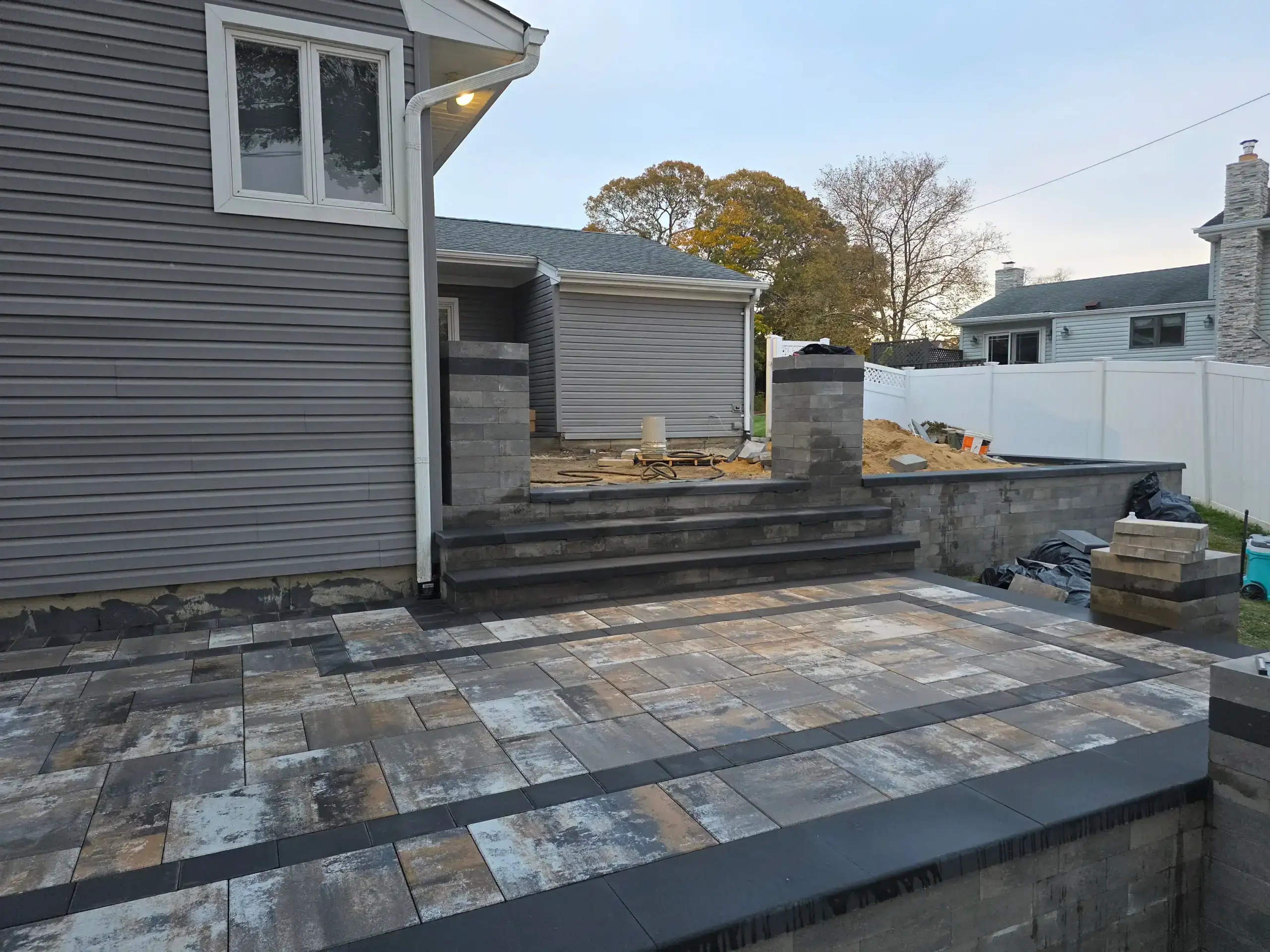
The smarter financial question isn’t “how do I avoid spending money on this?” It’s “am I spending money on this in a way that actually solves it?” A properly installed replacement patio — one built on a compacted gravel base with correct drainage grading — doesn’t have the same failure points as the slab you’ve been patching. It’s not a luxury upgrade. It’s a structural fix that happens to look a lot better when it’s done.
According to the National Association of REALTORS®, patios can recover up to 95% of their installation cost at resale. If you’re in a home you plan to sell in the next five to ten years, a patio remodel isn’t just a quality-of-life improvement — it’s a documented investment.
Want live answers?
Connect with a Corsino Construction expert for fast, friendly support.
A lot of homeowners put off patio projects because they’re not sure what they’re getting into — the disruption, the timeline, the process. That uncertainty is reasonable, but it’s also worth clearing up, because a well-run patio remodel is less invasive than most people expect.
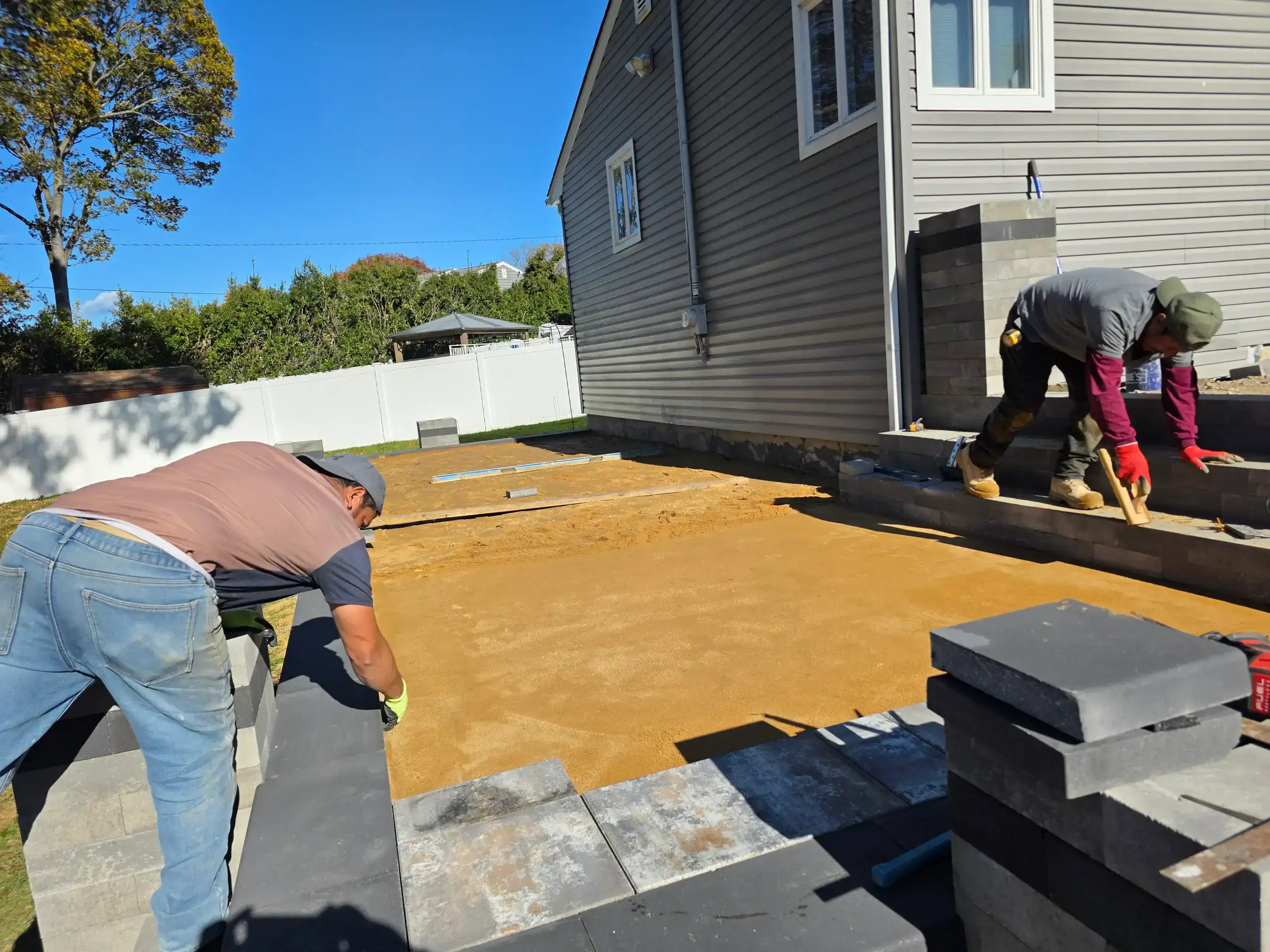
The work starts with removing the existing slab, excavating down to stable ground, and building a proper compacted base. That base layer is the part that determines how long your new patio lasts. Everything above it — the material, the finish, the design — is secondary to what’s underneath. A patio that fails in five years almost always failed because the base work was rushed or skipped.
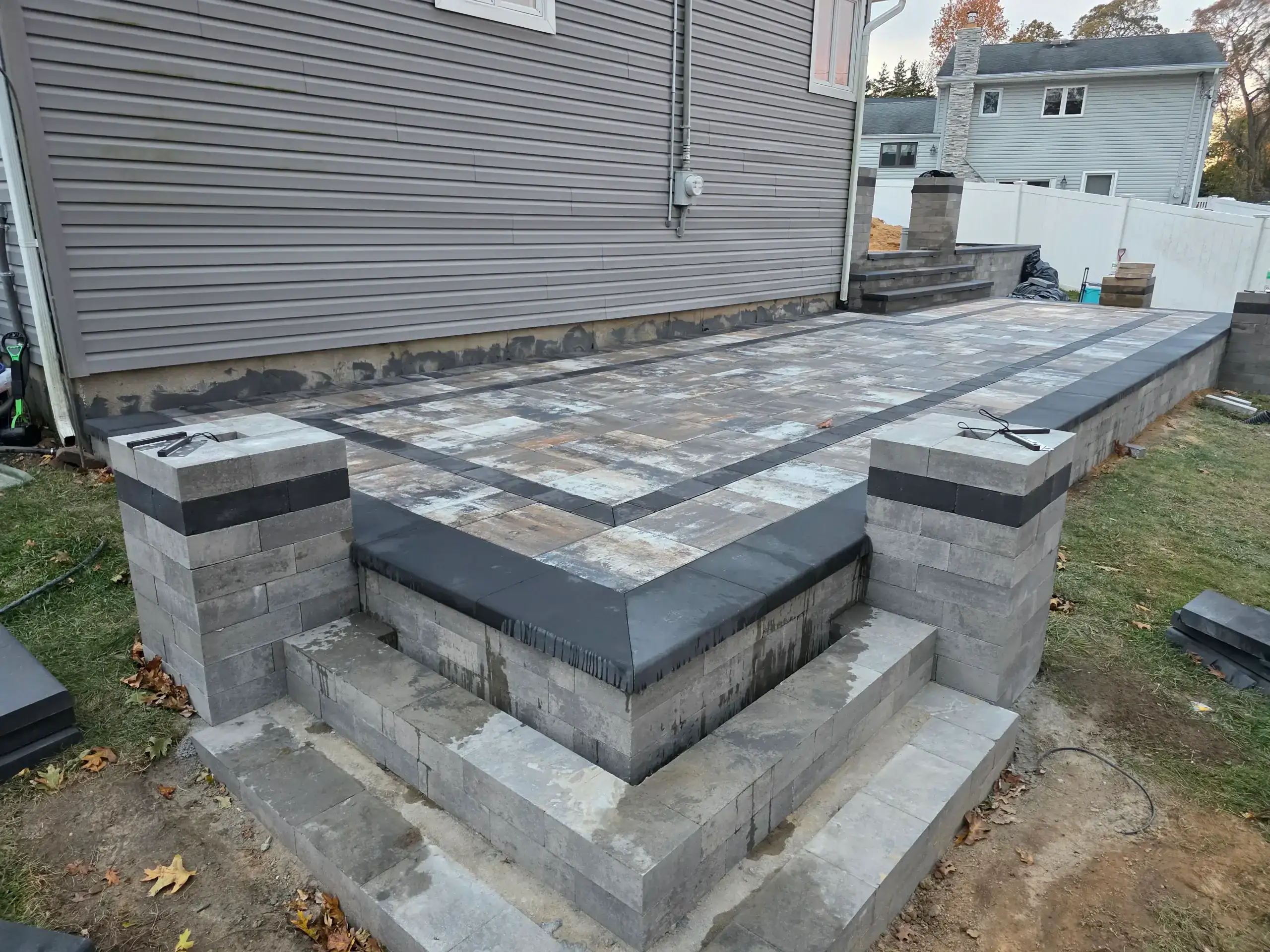
The two most common options for patio remodeling in Suffolk County are poured concrete and paver systems, and they perform differently in Long Island’s climate. Neither is universally better — it depends on your priorities, your budget, and how you use the space.
Poured concrete is straightforward, durable, and cost-effective for larger areas. The downside is that when it cracks — and eventually it will, as anyone in the industry will tell you — you’re dealing with the slab as a whole unit. Repairs are visible and rarely seamless. If you go the concrete route, the quality of the base preparation and the drainage design matter enormously.
Paver systems handle freeze-thaw cycles differently. Because individual pavers can shift slightly and be reset, they tend to tolerate ground movement better than a monolithic slab. If a section settles unevenly, you can lift and relay those pavers without disturbing the rest of the patio. That flexibility is one reason paver installations have become the preferred choice for a lot of Suffolk County homeowners — particularly in areas with more active soil movement.
There are also hybrid approaches worth considering. If your existing concrete slab has a sound base but a deteriorated surface, veneering over it with stone or pavers is sometimes a viable option — but only when the base is genuinely stable. If the base has been compromised by shifting soil or drainage issues, no surface treatment will hold for long. That assessment is something a qualified contractor needs to make in person, not something you can determine from photos.
Whatever material you choose, the installation standards matter more than the material itself. Proper excavation depth, a correctly graded base, and drainage that moves water away from the slab and away from your foundation — those are the factors that separate a patio that lasts 30 years from one that needs to be replaced again in a decade.
Hiring a contractor for a patio remodel is where a lot of homeowners have been burned before — and where the anxiety around this kind of project really comes from. The work itself is straightforward. The contractor selection process is where things go sideways.
A few things are worth verifying before you commit. First, licensing. In Suffolk County, home improvement contractors are required to hold a Home Improvement Contractor license issued by the Suffolk County Department of Consumer Affairs. Ask for it. A legitimate contractor will have it and won’t hesitate to share it. Alongside that, general liability insurance and workers’ compensation coverage are non-negotiable — if someone gets hurt on your property and the contractor isn’t properly insured, you’re exposed.
Second, ask directly whether the crew doing your job is employed in-house or subcontracted out. This matters more than most homeowners realize. When a contractor subs out the work, you lose continuity — different people show up at different stages, accountability gets diffuse, and when something doesn’t meet your expectations, there’s no single person responsible for fixing it. An in-house crew means the same people who start your project finish it, and the contractor stands behind the work because their own team did it.
Third, get the pricing in writing before anything starts — and make sure it’s a fixed price, not an estimate that can grow. Scope creep and hidden fees are the most common complaints homeowners have after contractor projects go wrong. A contractor who commits to a number upfront and holds to it unless you change the scope is a contractor who’s confident in their process.
Finally, look at their track record in your area specifically. A company that has been operating in Suffolk County for 20-plus years and can point to completed projects in towns near yours has navigated Long Island’s soil conditions, climate patterns, and local building codes for a long time. That local experience is worth something — it’s the difference between a contractor who knows why certain materials fail after harsh Long Island winters and one who is learning that lesson on your driveway.
If your patio is cracked, uneven, draining poorly, or just past the point where another repair makes sense, the clearest thing you can do is get a professional set of eyes on it. Not to commit to anything — just to know what you’re actually dealing with.
The decision between a repair and a full patio remodeling project comes down to what’s happening at the base level, and that’s not something you can assess from the surface. Once you know, you can make a real decision instead of guessing your way through another season.
We’ve been working with Suffolk County homeowners since 2000 — in Coram, Huntington, West Islip, Holbrook, Smithtown, Bay Shore, and throughout the county. If you want a straight answer about what your patio needs, we offer free estimates with no pressure and no surprises. Reach out by phone or text at 516-693-4270, Monday through Friday, 9am to 5pm.
Article details:
Share:
Continue learning: