Discover why travertine and smart drainage solutions make pool patios safer and longer-lasting in Medford and Patchogue, with expert guidance on avoiding costly mistakes.
Share:
Summary:
You’ve invested in a pool to create memories with your family, but if your pool patio becomes a slip hazard every time someone gets out of the water, or if you’re dealing with puddles that won’t drain, that investment loses its appeal fast. Standing water isn’t just annoying. It stains your deck, breeds mosquitoes, and can even damage your home’s foundation if it’s draining the wrong direction.
The good news is that the right combination of materials and drainage design prevents these problems before they start. Travertine pavers offer natural slip resistance and stay cool underfoot, while properly installed drainage systems keep water moving where it should. Let’s walk through what actually works for pool patios in Suffolk County, where our clay soil, freeze-thaw cycles, and coastal humidity create challenges that generic solutions can’t handle.
Travertine has been used as a building material since ancient Rome for good reason. It’s naturally porous, which means water gets absorbed into the surface instead of sitting on top creating slick spots. That matters when you’ve got wet feet coming out of the pool all day.
The same porous quality that makes travertine slip-resistant also helps it stay cool. Even when temperatures hit the high 80s or low 90s in Medford and Patchogue, travertine reflects heat and pulls coolness from the ground below. You can walk barefoot comfortably, which isn’t something you can say about concrete or many other paving materials that turn into hot plates under direct sun.
Suffolk County’s climate throws some curveballs at pool patios. Our winters bring freeze-thaw cycles that crack materials that can’t handle expansion and contraction. Coastal humidity and salt air wear down surfaces that work fine inland. Travertine handles both because it’s dense natural stone that’s been forming in hot springs for thousands of years. It doesn’t fade, chip easily, or deteriorate from pool chemicals the way some alternatives do.
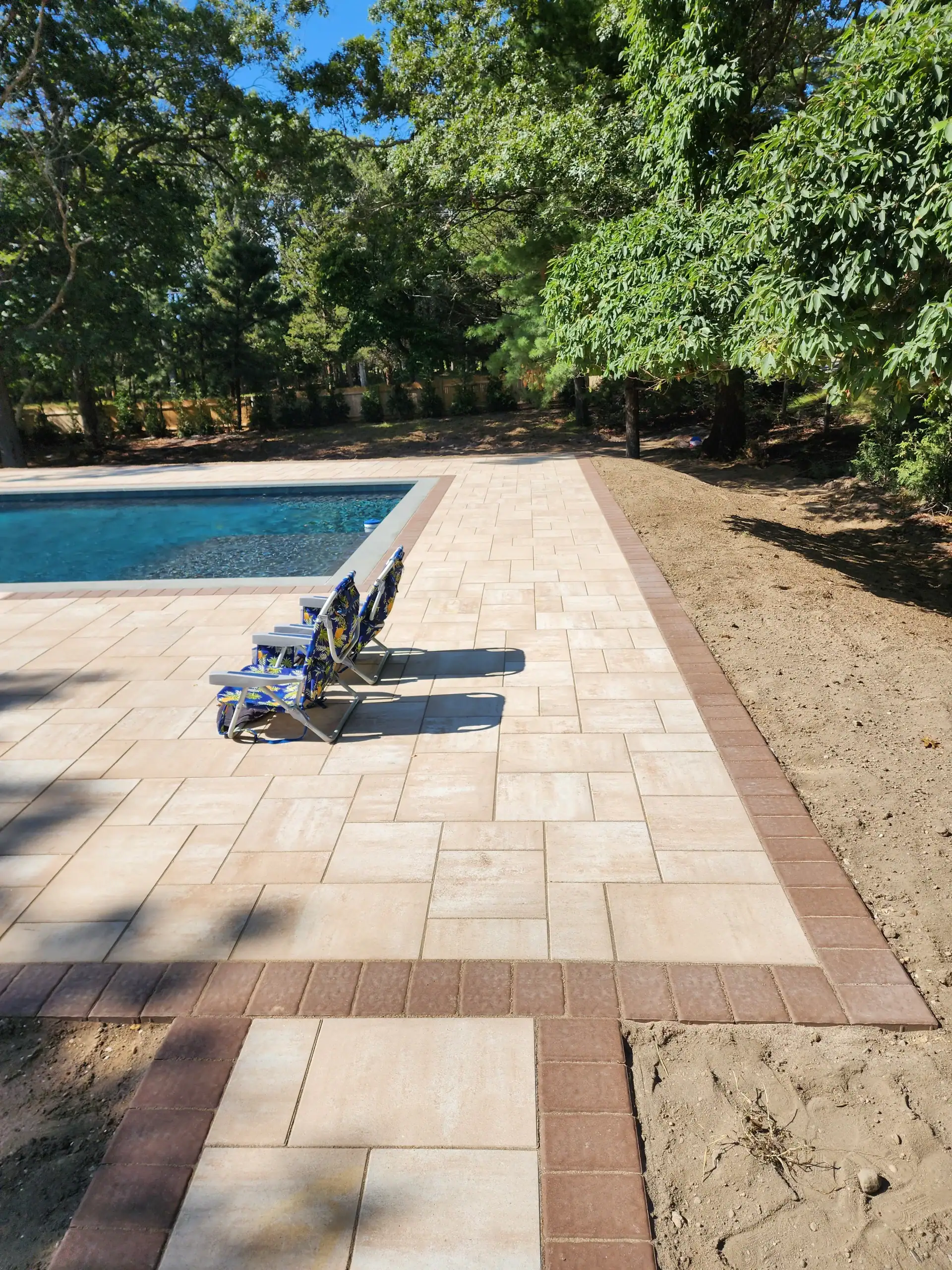
The slip resistance comes down to how travertine forms and how it’s finished. This natural stone develops with small holes and an irregular texture as minerals deposit in hot springs. Those imperfections are exactly what create traction when the surface is wet.
Water doesn’t puddle on travertine the way it does on smooth concrete or sealed pavers. Instead, it gets absorbed into those pores and drains through. That means less standing water and better grip for bare feet. The absorption happens quickly enough that even during heavy pool use, the surface maintains traction.
Finish matters too. Tumbled travertine has an even more textured surface than standard cuts, which increases slip resistance further. A honed finish provides a smooth look while keeping enough natural texture for safety. You don’t want a polished finish around pools because that defeats the traction benefit, but most pool-specific travertine comes in appropriate finishes.
The natural variation in travertine also means no two pavers are identical. That irregularity creates micro-variations in surface height and texture that improve grip. It’s the opposite of a perfectly smooth surface where water creates a film between your foot and the material.
One thing to understand is that travertine stays slip-resistant without needing special coatings or treatments that wear off over time. The traction is built into the stone itself. You’re not depending on a sealant to keep your family safe, which means one less thing to maintain and replace every few years.
For Suffolk County pool patios specifically, this matters because our humid summers mean surfaces stay wet longer than they would in drier climates. A material that naturally handles moisture without becoming slippery gives you consistent safety rather than depending on how recently it rained or how many people have been in the pool.
Long Island throws everything at outdoor surfaces. Winter brings freeze-thaw cycles where water gets into cracks, freezes, expands, and breaks things apart. Spring and fall bring temperature swings. Summer delivers intense UV exposure, high humidity, and salt air from the coast. Your pool patio needs to handle all of it without falling apart.
Travertine’s density gives it an advantage here. It’s not prone to the surface cracking you see with concrete after a few harsh winters. The stone can handle the expansion and contraction that comes with temperature changes because it’s been doing exactly that in natural environments for millennia before anyone cut it into pavers.
The key is getting premium-grade travertine and installing it properly. Standard grade travertine has more surface holes and less density, which means water can get in, freeze, and cause problems. Premium select grade is denser with fewer holes, so it handles freeze-thaw cycles without popping or cracking. That grade difference matters in Suffolk County’s climate.
Installation method matters just as much as material quality. Travertine needs to be dry-set in freeze-thaw climates like ours, not mortared down. Dry-set installation allows the pavers to expand and contract with temperature changes without cracking. When pavers are mortared, they can’t move, and that restriction causes cracks to form.
The base preparation under your travertine determines whether it lasts five years or fifty. Suffolk County has clay soil that expands when wet and contracts when dry. If your contractor doesn’t account for that movement with proper base thickness and compaction, you’ll see settling and cracking within a couple of years. The travertine itself might be fine, but if the base fails, everything above it fails too.
Coastal salt air is another factor. It corrodes some materials and causes others to deteriorate. Travertine is limestone-based natural stone that’s been exposed to mineral-rich water during its formation. It doesn’t react to salt air the way metal or some composite materials do. You won’t see the fading or surface degradation that happens with materials not designed for coastal environments.
UV exposure from direct sunlight also affects longevity. Some materials fade or become brittle with constant sun exposure. Travertine’s natural earth tones are the color of the stone itself, not a surface treatment or dye. The color goes all the way through, so even if the surface weathers slightly over decades, you won’t see the dramatic color change that happens with dyed concrete or some pavers.
Want live answers?
Connect with a Corsino Construction expert for fast, friendly support.
Drainage might not be the exciting part of pool patio planning, but it’s the difference between a project that performs for decades and one that creates problems within a year. Standing water around your pool isn’t just unsightly. It creates slip hazards, stains your pavers, breeds mosquitoes, and can cause serious damage if it’s draining toward your home’s foundation.
The basic principle is simple: water needs to move away from both your pool and your house. Pool decks should slope about a quarter inch per foot. That means an eight-foot-wide patio section should have roughly two inches of fall from one side to the other. That’s enough to move water without creating an obvious tilt you’d notice visually.
Where the water goes matters as much as the slope itself. You can’t just push water off your pool deck and onto your lawn or landscaping. Pool water contains chlorine that kills plants. Even rainwater runoff can drown plants or erode soil if it’s all concentrated in one spot. Proper drainage systems channel water to specific collection points where it can be managed without causing other problems.
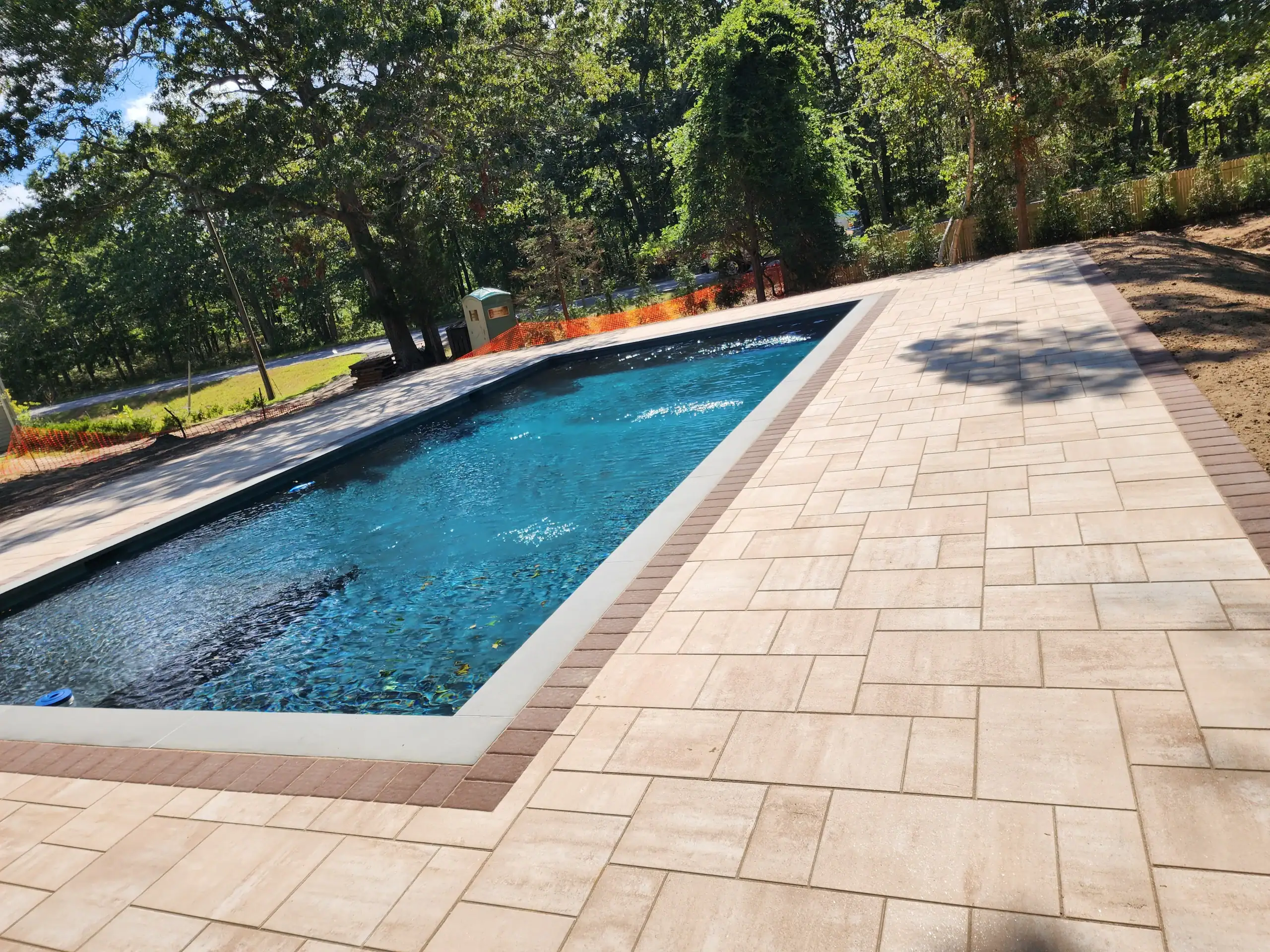
The most obvious drainage problem is standing water that won’t drain. You see puddles on your pool deck hours or even days after rain or pool use. That water becomes a breeding ground for mosquitoes, creates slip hazards, and leaves mineral deposits or stains on your pavers. If you’re constantly sweeping water off your deck or using a leaf blower to dry it, your drainage system isn’t working.
Water draining toward your house is a more serious problem that needs immediate attention. When pool water or rainwater runs toward your foundation instead of away from it, you’re looking at potential basement flooding, foundation damage, and even structural issues. Some homeowners don’t realize this is happening until they notice dampness in their basement or see erosion near their foundation.
Clogged drains are common in pool areas because debris, leaves, mulch, and dirt get washed around during storms. Strip drains and catch basins work great when they’re clear, but if they’re clogged, water backs up and puddles exactly where you don’t want it. Regular maintenance prevents this, but many homeowners don’t think about checking drains until there’s already a problem.
Deck slabs that have tilted or settled create low spots where water collects. This happens when the base wasn’t properly compacted during installation, or when freeze-thaw cycles cause movement. Clay soil in Suffolk County makes this more likely because it expands and contracts with moisture. What starts as a small settling issue becomes a permanent puddle that won’t drain no matter how good your drainage system is.
Landscaping changes can also create drainage problems. If you’ve added raised planter beds along the edge of your pool deck without leaving space for water to drain, you’ve essentially created a dam. Water hits the planter and has nowhere to go, so it pools at the corners or backs up onto your deck. The same thing happens if soil has built up over time at the edges where drainage used to work fine.
French drains around pools can become clogged over time, especially if trees are nearby. Roots are attracted to the water source and grow into the drainage pipes. Soil and debris also accumulate in the gravel bed. A French drain that worked perfectly for ten years might suddenly stop functioning because it’s completely clogged. You won’t see the problem until water starts backing up.
Sometimes the drainage system was never installed correctly in the first place. Pipes that aren’t sloped properly won’t drain completely, leaving standing water in the lines. Drain fields that don’t have enough gravel or proper soil underneath can’t absorb the volume of water being directed to them. These installation errors might not show up immediately, but they become obvious the first time you get a heavy rain.
Strip drains, also called trench drains or channel drains, are one of the most effective solutions for pool patios. These are long, narrow grates covering a trench that collects water and directs it away from your patio. They work particularly well when your pool deck runs up against your house, creating a valley where water naturally flows. The strip drain catches that water before it reaches your foundation.
Installation requires cutting a trench at the low point of your patio slope, installing the drain channel, and connecting it to pipes that carry water to an appropriate discharge point. The discharge might be to a lower area of your yard, a dry well, or your property’s existing drainage system. What matters is that water moves completely away from both your pool area and your home.
Spot drains work better for free-form pool decks where you can’t easily install a long strip drain. These are round drains placed at strategic low points, connected by underground piping. Multiple spot drains can cover a large patio area, with all of them feeding into the same drainage system. They’re less visible than strip drains, which some homeowners prefer aesthetically.
The key with spot drains is placing them correctly based on your patio’s slope and shape. Water needs to flow naturally toward the drain locations. If you put a spot drain in the wrong place, water will flow past it and puddle somewhere else. This is where experience with Suffolk County properties matters, because contractors familiar with local soil conditions and typical yard grading can predict water flow patterns.
French drains work well for managing water around the perimeter of your pool patio. These are gravel-filled trenches with perforated pipes that collect water that’s soaked through the ground. They’re particularly useful when you have water coming from uphill areas of your yard that would otherwise flood your pool deck during heavy rain. The French drain intercepts that water before it reaches your patio.
For French drains to work long-term in Suffolk County, they need proper depth (usually 12 inches by 12 inches), quality gravel that won’t compact over time, and pipes that maintain their slope. The discharge point needs to be lower than the drain itself so gravity keeps water moving. If a French drain is installed flat or with improper slope, water sits in the pipes instead of draining completely.
Combining drainage solutions often works best. You might have a strip drain along your house, spot drains in low areas of your patio, and a French drain managing water from your yard. The systems work together to handle different water sources and ensure nothing backs up or overwhelms a single drain.
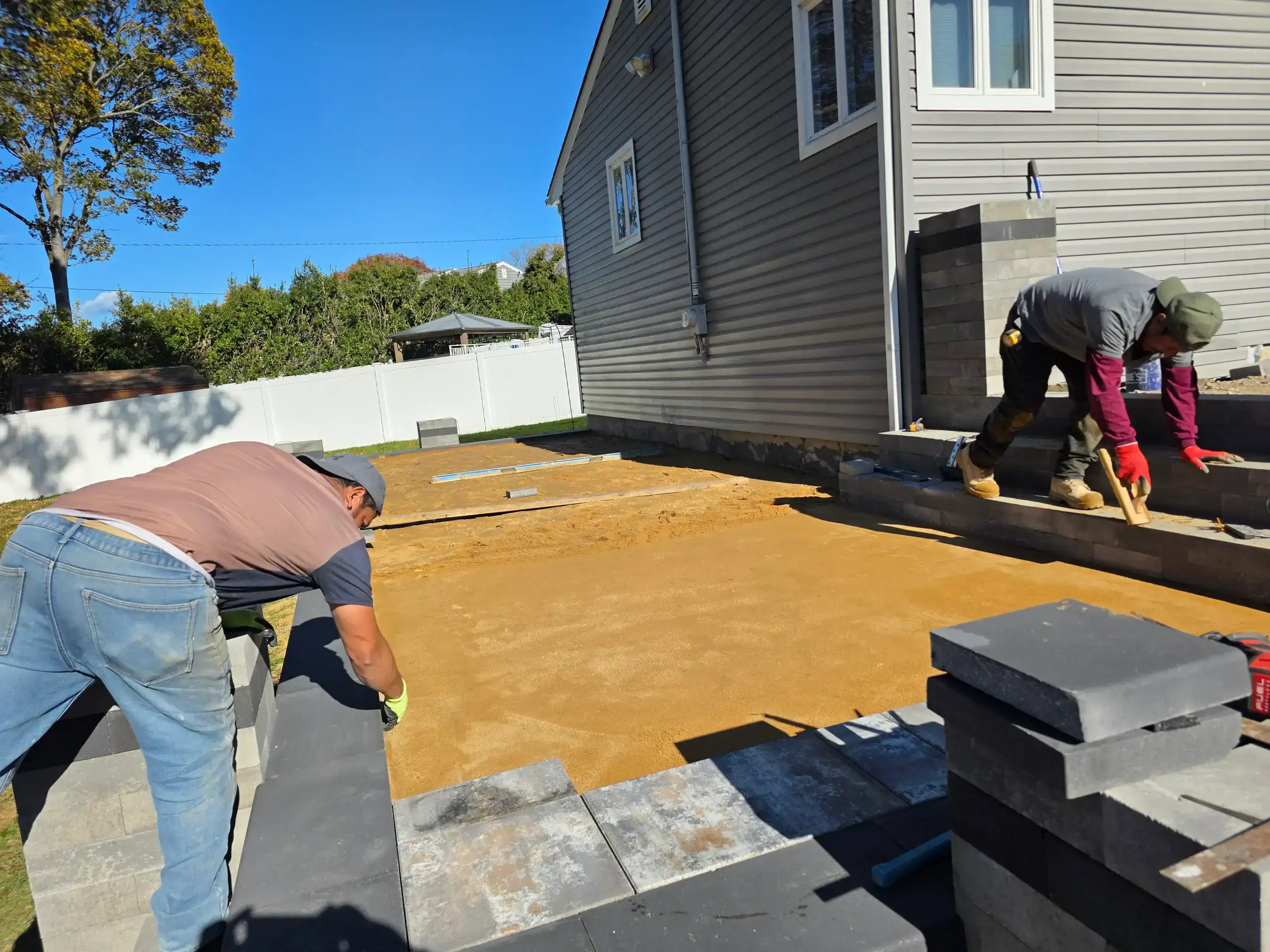
Base preparation is part of drainage too, even though people don’t always think of it that way. A properly compacted base with the right materials allows water to move through rather than pooling underneath your pavers. If water gets trapped under your pool deck, it can cause settling, frost heaving, and eventual failure of the surface above. The base needs to be permeable while still providing solid support.
Travertine’s natural porosity helps with surface drainage, but you still need proper slope and drainage systems. The water that absorbs into travertine has to go somewhere. If it just saturates the base underneath with no way to drain away, you’ll eventually have problems. Think of the travertine as the first stage of drainage and your slope and drain systems as the second stage that completes the job.
A safe, long-lasting pool patio in Medford or Patchogue comes down to two things: choosing materials that handle our local climate and installing drainage systems that actually work. Travertine gives you natural slip resistance and temperature control that makes your pool area safer and more comfortable. Proper drainage prevents the standing water, foundation damage, and premature failure that plague poorly designed installations.
The difference between a pool patio that performs for decades and one that needs expensive repairs within a few years usually isn’t the material cost. It’s whether your contractor understands Suffolk County’s clay soil, freeze-thaw cycles, and drainage requirements. It’s whether we’re using premium-grade materials and taking time to prepare the base correctly instead of rushing through to the next job.
If you’re planning a pool patio project or dealing with problems with your current one, we’ve been handling these installations throughout Suffolk County since 2000. Our licensed in-house team knows how to select the right materials, design drainage that works, and install everything to last.
Article details:
Share:
Continue learning: