Suffolk County winters are hard on walkways. Here's what you need to know before choosing between pavers and concrete.
Share:
Summary:
You’ve patched the same crack twice. Maybe three times. It keeps coming back, a little worse each spring, and now the whole section has shifted just enough to become a tripping hazard you’re embarrassed to walk guests over.
If you’re a homeowner in Suffolk County weighing pavers against concrete for your walkway, you’re asking the right question — and the answer here is different than it would be in a milder climate. Long Island winters are genuinely hard on hardscape. What holds up in Charlotte or Phoenix doesn’t necessarily hold up in Coram or Centereach.
We’ve installed hundreds of walkways across Suffolk County since 2000. We’ve seen what works and what fails. Let’s talk through what actually matters, including how your walkway fits into your broader exterior home remodeling plans.
The core difference between pavers and concrete isn’t cosmetic — it’s structural. Concrete is a monolithic slab. When the ground underneath it moves, the slab has nowhere to go. It cracks.
Pavers are individual interlocking units. When the ground shifts, they shift with it and stay intact.
That distinction becomes critical when you factor in what Long Island winters actually do. Suffolk County sees somewhere between 30 and 40 freeze-thaw cycles every single winter. Each one puts stress on whatever surface is sitting on top of that ground. Concrete fights that stress and eventually loses. Pavers accommodate it.
Most concrete walkways in Suffolk County start showing cracks within two to three years. That’s not a contractor quality issue — it’s a physics issue.
When water seeps into the surface and freezes, it expands. That expansion can exert up to 25,000 PSI of pressure inside a crack or pore. Do that 30 to 40 times a winter, and even a well-poured slab starts to give.
There’s also a chemical problem that most people don’t think about. Calcium hydroxide — a natural byproduct of concrete — reacts with calcium chloride, the most common road salt, to form expanding crystals inside the concrete matrix. This reaction doesn’t stop. Every time salt migrates into the slab and the temperature drops, those crystals grow a little more. The result is spalling, scaling, and surface breakdown that no amount of sealing can fully reverse once it starts.
Suffolk County’s soil makes this worse. Areas like Brookhaven, Coram, Medford, and Centereach have significant clay content in the ground. Clay expands when it absorbs water and contracts when it dries out. That movement is happening underneath your walkway independent of temperature. A concrete slab sitting over clay soil is dealing with freeze-thaw stress from above and soil movement stress from below. The math isn’t in concrete’s favor.
And then there’s the repair problem. When a section of concrete cracks or heaves, you can’t just swap out the damaged piece. You have to cut, demo, repour, and wait for it to cure — and the patch will never quite match the original color. You end up with a walkway that looks worse after the repair than it did before, and the underlying conditions that caused the crack in the first place haven’t changed.
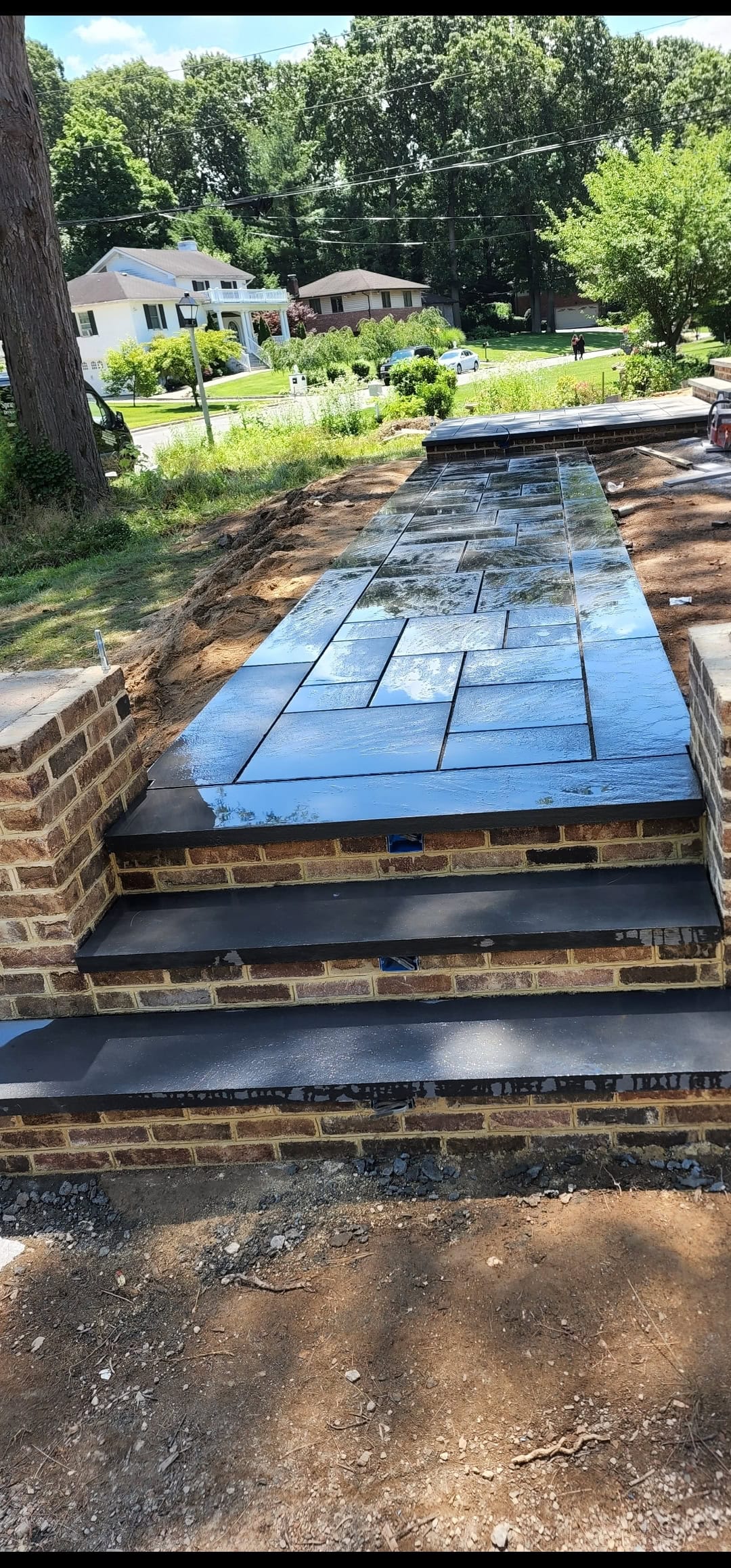
Pavers don’t crack under freeze-thaw pressure for the same reason they don’t crack when a car rolls over them — the load gets distributed across individual units rather than absorbed by one continuous slab. When one paver shifts slightly, its neighbors accommodate it. The system flexes. Nothing breaks.
That flexibility also makes repairs straightforward in a way that concrete simply isn’t. If a paver gets damaged — whether from a heavy impact, a tree root, or a particularly brutal winter — you pull the affected unit, address whatever caused the problem, and drop in a replacement. The new paver matches because it’s the same material, not a poured patch trying to mimic an aged surface.
Salt resistance is another real advantage, but it comes with a caveat. Properly sealed pavers resist the calcium chloride reaction that destroys concrete. The sealer acts as a barrier, keeping salt from penetrating the surface and starting that chemical process. But unsealed pavers in Long Island conditions can degrade noticeably within seven years — fading, spalling, and eventually looking a lot like the bare concrete you were trying to avoid.
Sealing every few years isn’t optional in Suffolk County; it’s part of what makes pavers the better long-term choice in this climate.
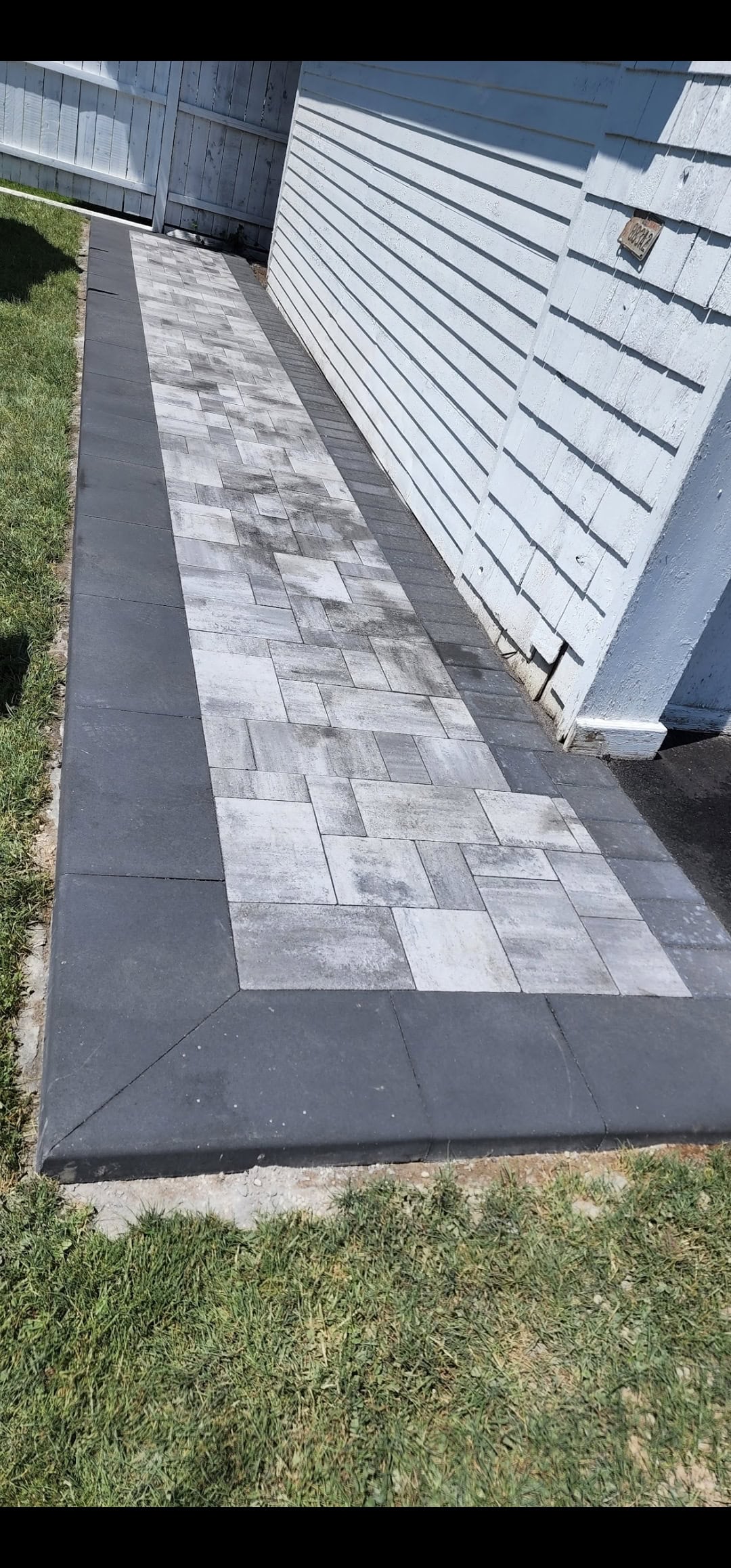
The other thing pavers do well that concrete doesn’t is drain. The joints between individual units allow water to move down and away from the surface rather than pooling on top. Pooled water freezes into ice patches. Ice patches are where walkway injuries happen. A well-installed paver system with proper drainage grading reduces that risk in a way a solid concrete slab can’t match.
Want live answers?
Connect with a Corsino Construction expert for fast, friendly support.
The sticker price comparison is real. Concrete walkways generally run $6 to $12 per square foot. Pavers typically fall in the $10 to $30 per square foot range depending on material, pattern, and site conditions. That gap is visible on day one, and it’s the reason a lot of homeowners lean toward concrete before they’ve thought through what the next decade looks like.
The problem is that concrete’s lower upfront cost assumes a lifespan that Long Island’s climate doesn’t reliably deliver. When you factor in the cost of repeated patching, sealing, and eventual full replacement — which often happens within 10 to 15 years in our climate — the math shifts considerably. Pavers installed correctly tend to last 25 to 30 years in Long Island conditions with predictable, manageable maintenance. That’s a different kind of investment.
Think about what concrete maintenance actually looks like over time. Year two or three, you notice the first cracks and seal them. Year five, the patching starts. Year eight, the patches are obvious and the surface is uneven enough that you’re watching where you step. Year twelve, you’re getting quotes to tear it all out and start over — which costs roughly what a paver installation would have cost in the first place, minus the years of frustration and repeated repair bills.
That cycle isn’t hypothetical. It’s the standard trajectory for concrete walkways in Suffolk County, where the combination of freeze-thaw frequency, clay soil movement, and aggressive road salt use creates conditions that wear concrete down faster than most homeowners expect when they’re making the initial decision.
Pavers have their own maintenance requirements, but they’re more predictable and less urgent. Joint sand needs replenishment roughly every three to five years. Sealing every few years keeps the surface protected and looking sharp. Neither of those tasks involves demolition, curing time, or color-matching problems. You’re maintaining a surface that still looks like itself, not trying to disguise a repair.
In a market where the median home in Suffolk County sells for around $680,000, the curb appeal difference between a well-maintained paver walkway and a patched-up concrete slab is also worth thinking about. The front entrance is the first thing buyers see. A cracked, patched walkway signals deferred maintenance throughout the property. A clean, well-installed paver walkway signals the opposite — and that impression happens before anyone opens the front door.
Here’s the part most comparison articles skip. The paver itself is the wearing surface. The base underneath it is the structural layer. And the base is where most installations either succeed or fail within the first few years.
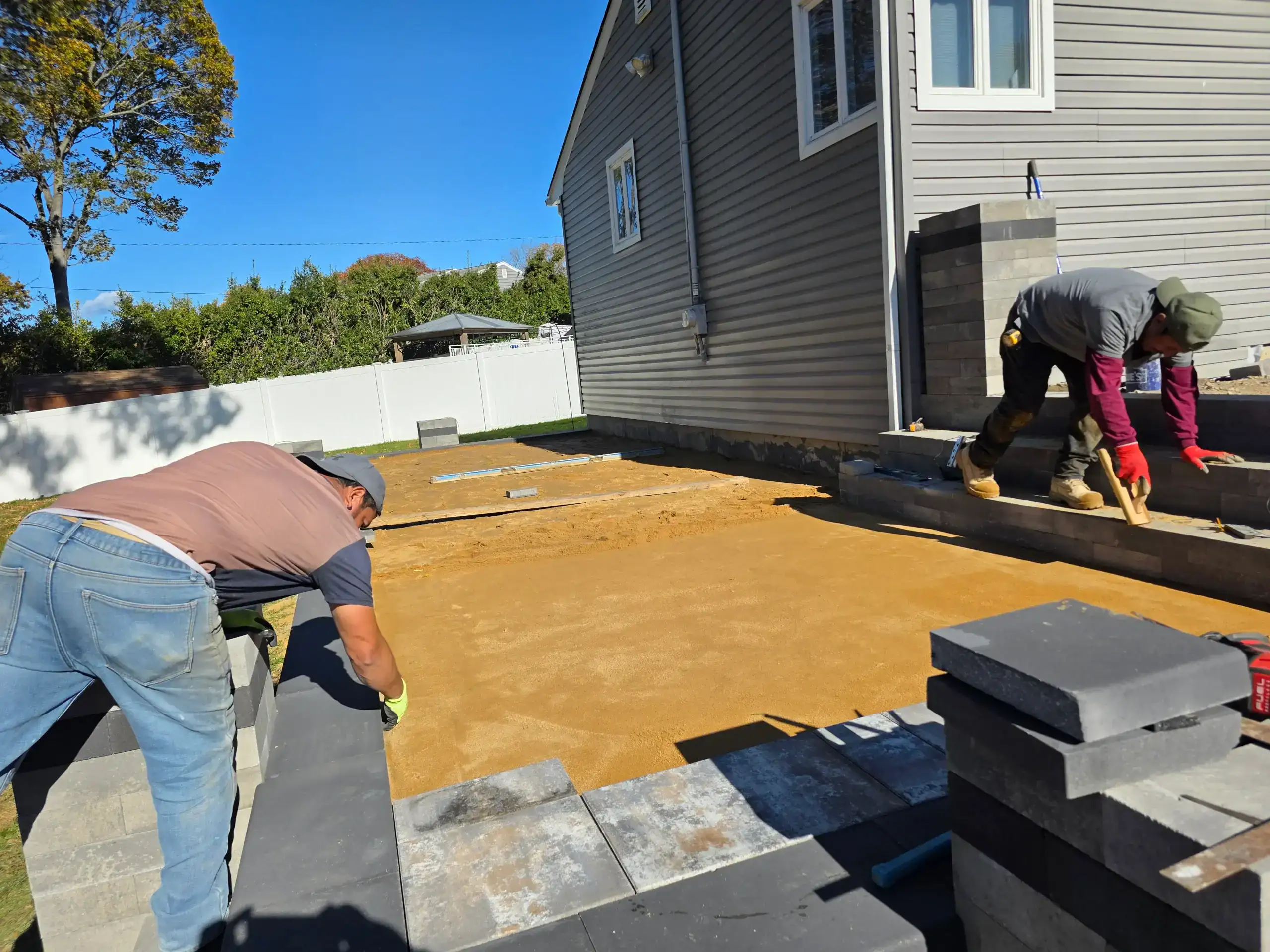
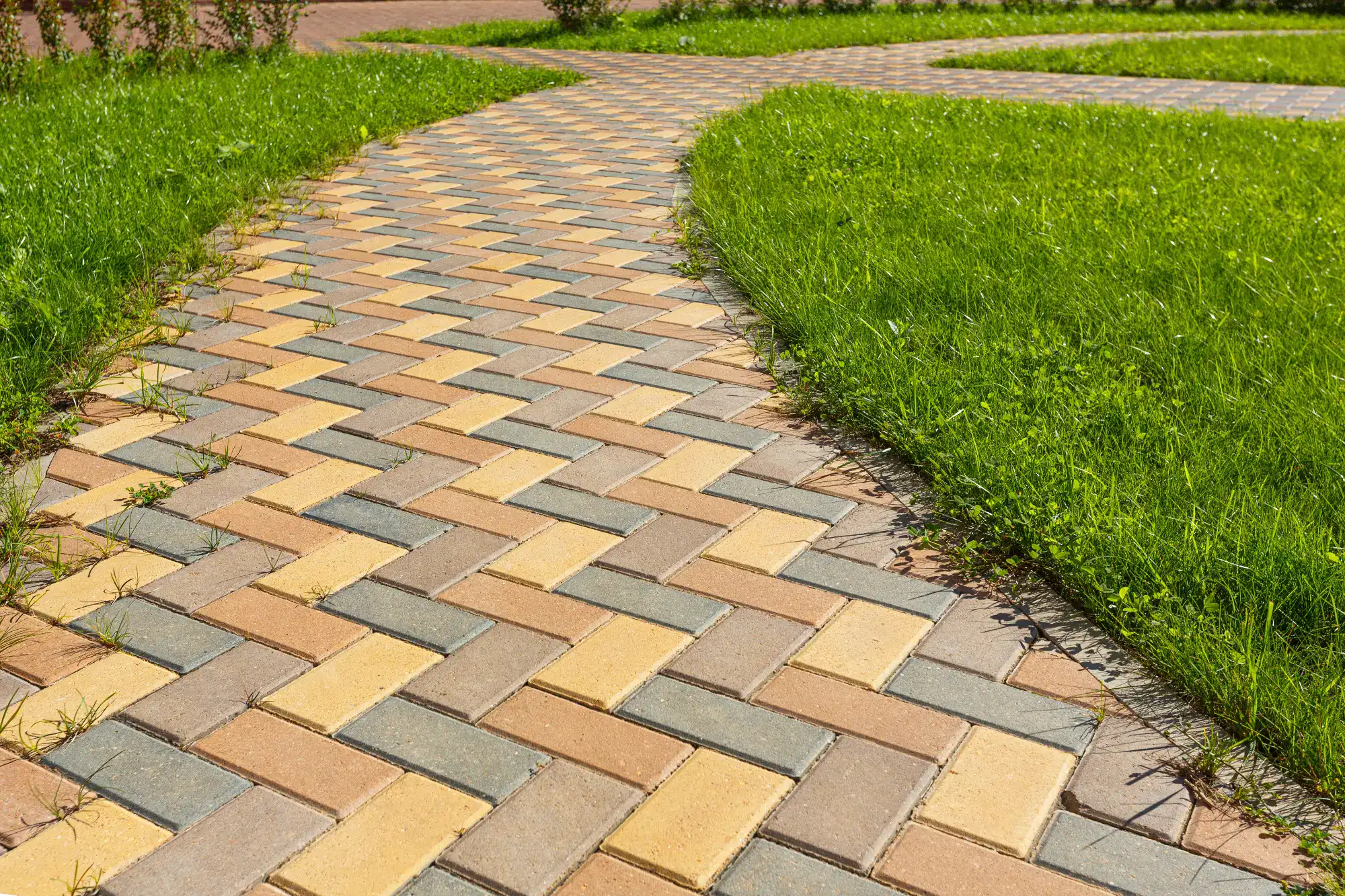
A properly installed paver walkway requires excavation to roughly 7.5 inches, with compacted base material installed in controlled lifts and compacted to proper density. Drainage grading gets established during excavation so water moves away from the foundation rather than pooling underneath the surface. Edge restraints go in to prevent lateral migration. Bedding sand gets screeded level before a single paver is placed. Then the finished surface gets compacted with a plate compactor and polymeric sand gets worked into the joints to lock everything together and inhibit weed growth.
That’s the process when it’s done right. The reason some paver walkways sink, shift, and create new tripping hazards within a few years isn’t a material problem — it’s a base preparation problem. A contractor who rushes or skips those foundation steps is essentially building on sand. The pavers will move because there’s nothing stable underneath them.
This is why the contractor decision is inseparable from the material decision. You can choose the right material and still end up with a failing walkway if the base work isn’t done properly. At Corsino Construction Corp, every walkway project is handled by our in-house licensed crew — not subcontractors. The same team that does the excavation does the base prep and the installation. There are no handoffs, no unknown variables, and no shortcuts taken at a stage you’ll never see. We’ve been doing this work in Suffolk County since 2000, and the base is where we spend the most time, because that’s what actually determines whether a walkway lasts five years or thirty.
We also provide detailed, fixed-price estimates before any work begins. What we quote is what you pay — no adjustments after the job starts, no line items that appear at the end. If you’ve been burned by vague contractor estimates before, that’s exactly why we operate the way we do.
For most Suffolk County homeowners replacing a front walkway, pavers are the stronger choice — not because they look better on day one, but because they’re built for what Long Island winters actually do. The freeze-thaw flexibility, the individual-unit repairability, the salt resistance with proper sealing — those aren’t marketing points. They’re engineering advantages that show up in real performance over time.
Concrete isn’t without its place. A narrow utility path on the side of the house that nobody sees and nobody salts aggressively is a different conversation. But for a front walkway in Brookhaven, Huntington, Centereach, or anywhere else in Suffolk County where winters are real and guests actually use the path, pavers consistently outperform concrete over the long run.
If you’re ready to stop patching and start with something built to last, we’re happy to take a look at your property and give you a straight answer about what it will take and what it will cost. Call Corsino Construction Corp today.
Article details:
Share:
Continue learning: