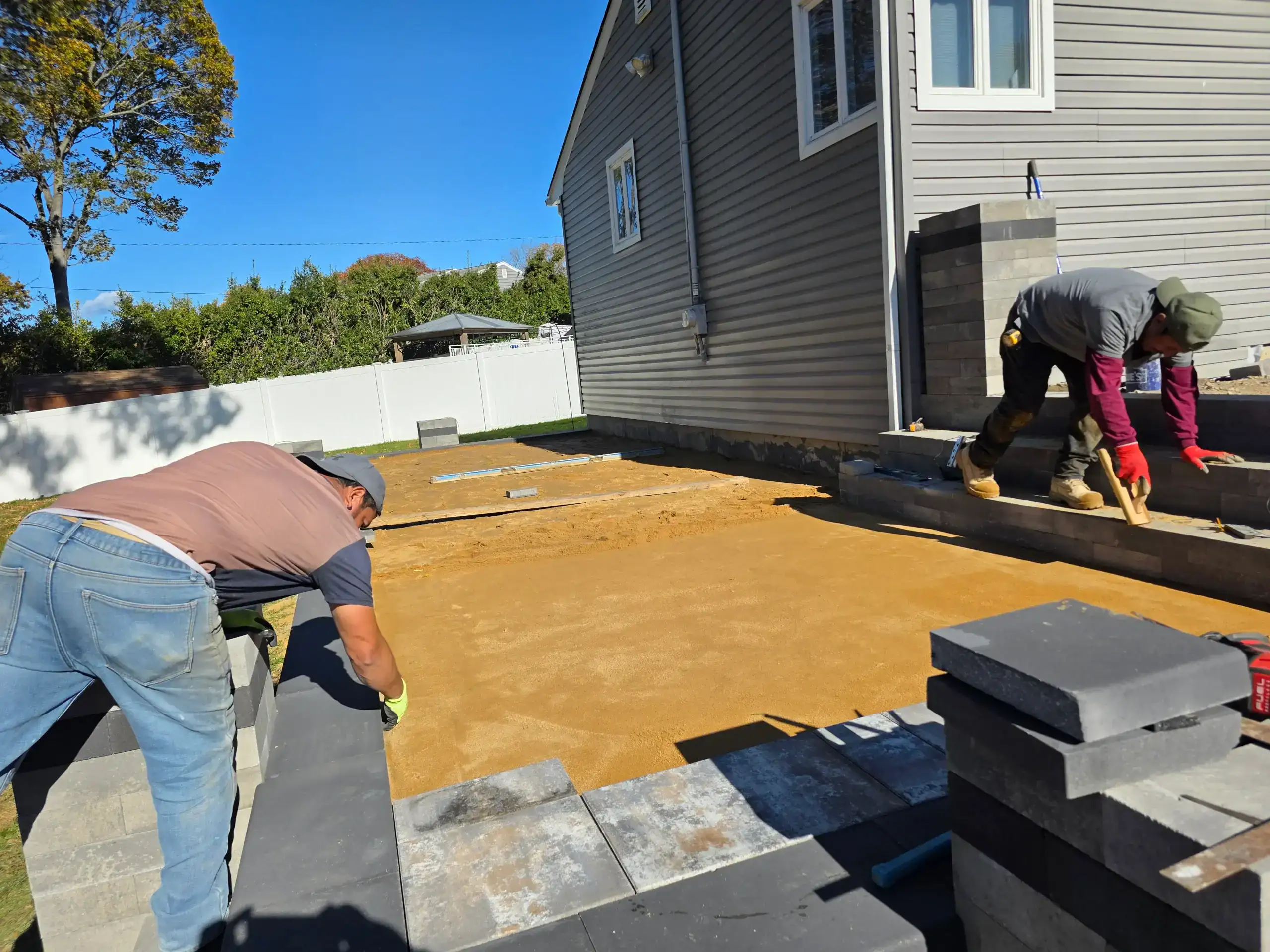
Not all contractors are who they say they are. Here's how Suffolk County homeowners can verify credentials, avoid common traps, and hire with confidence.
Share:

Summary:
You’ve probably already looked at a few contractors. Maybe you’ve gotten some quotes. And now you’re doing what most careful homeowners do — trying to figure out who’s actually legitimate before you hand over a deposit. That’s a smart move, especially in Suffolk County, where the licensing rules are more specific than most people realize and where the wrong hire can mean unpermitted work, surprise costs, or a crew you’ve never met showing up at your door. If you’re still comparing your options, learning more about a general contractor can help you understand what to verify, what to ask, and what to watch out for — so you can commit to the right contractor with confidence.
The first thing most homeowners don’t know is that New York State does not issue a statewide home improvement contractor license. Licensing is handled county by county. A contractor who’s licensed in Nassau County is not licensed to work in Suffolk County. There’s no statewide database, no automatic crossover, and no workaround. If you’re in Coram, Selden, Centereach, or anywhere else in Suffolk County, the credential that matters is the Suffolk County Home Improvement Contractor license — issued by the Suffolk County Department of Labor, Licensing and Consumer Affairs.
You can verify any contractor’s license directly through the Suffolk County Consumer Affairs portal at aca-prod.accela.com/SUFFOLKCO. It takes about two minutes. If a contractor hesitates to give you their license number, or can’t name Suffolk County specifically as the issuing authority, that tells you what you need to know.

Getting licensed in Suffolk County isn’t a formality. Contractors have to pass a written exam, carry general liability insurance with a minimum of $500,000 in coverage, hold active workers’ compensation insurance, and pay both an application fee and a license fee. The license number is also required to appear on all advertising — so if you’re looking at a contractor’s website or a flyer and there’s no license number listed, that’s worth noting.
Beyond the license itself, ask for a Certificate of Insurance — commonly called a COI. This document shows the insurance company, the policy number, and the coverage limits. Don’t just take the contractor’s word for it. Call the insurance company directly to confirm the policy is active. It’s a two-minute call that has saved homeowners from serious financial exposure when something goes wrong mid-project.
Suffolk County also has a Licensed Home Improvement Contractor Restitution Fund, which exists specifically to help consumers who’ve been harmed by licensed contractors who failed to deliver. That fund only applies if the contractor was licensed to begin with — which is one more reason the license check matters before anything else.
A fair down payment is under 15% of the total contract value. If a contractor is pushing for 30%, 40%, or 50% upfront, that’s a red flag worth taking seriously. Legitimate contractors with established operations don’t need a large chunk of your money before a single wall has been touched.
New York General Business Law requires a written contract for any home improvement work over $500. If a contractor is offering a verbal estimate and moving toward a handshake deal, walk away. The contract should specify the materials being used — brands, quantities, model numbers when applicable — the timeline, the payment schedule, and the full scope of work. Vague contracts protect the contractor, not you.
Here’s something that doesn’t come up in most contractor conversations but probably should. When you hire a contractor, are you hiring their crew — or are you hiring someone who will then hire other people to do the actual work?
The subcontractor model is common in this industry, and it’s not always a problem. But it does introduce real risks. The people who show up on day one may not be the people you vetted. They may not know the scope of your project in detail. Their insurance coverage may be different from the contractor’s. And if something goes wrong, accountability gets complicated fast — because now there are two separate businesses involved in what happened to your home.
When you’re comparing home renovation contractors in Suffolk County, ask directly: will the people working in my home be your employees, or will you be using subcontractors? Ask whether every person on the job site is licensed and insured. Ask who your point of contact is throughout the project — not just during the estimate phase.
We’ve been working in Coram and the surrounding communities since 2000, and we’ve seen firsthand what happens when homeowners discover mid-project that the contractor they hired is managing five other jobs and has sent a crew they’ve never met. It creates communication breakdowns, quality gaps, and delays that are genuinely difficult to resolve once work has started. At Corsino Construction Corp, every person on your job site is part of our in-house, licensed team. No strangers showing up unannounced. No handoffs to crews we don’t supervise directly.
Want live answers?
Connect with a Corsino Construction expert for fast, friendly support.
Once you’ve verified credentials and asked the right questions, the next thing to understand is what a legitimate renovation project actually looks like from start to finish — so you know what normal looks like and what to push back on.
In Suffolk County, most renovation projects require permits. Structural changes, plumbing, electrical work — these aren’t optional. A contractor who tells you permits aren’t necessary for your project should be questioned carefully. Unpermitted work can trigger stop-work orders, fines, and in some cases requirements to open walls for inspection after the fact. We handle all permit coordination with the relevant building departments, and permit costs are included in the estimate upfront so there are no surprises later.

Most homeowners read reviews before hiring a contractor — and that’s the right instinct. But not all reviews tell you the same thing, and knowing what to look for makes a real difference.
Generic five-star reviews that say “great work, highly recommend” don’t give you much to go on. What you’re looking for are reviews that describe a specific project, name specific people, and explain what the experience was actually like — before, during, and after the work was done. Reviews that mention communication, punctuality, cleanup, and whether the final result matched what was promised are the ones that tell you how a contractor actually operates day to day.
Pay attention to whether reviews mention the same names repeatedly. When customers name individual crew members or the owner by name, it usually signals a company that’s small enough to maintain real relationships — not one that’s too large and spread thin to know who’s working on your job.
It’s also worth checking whether reviews mention word-of-mouth referrals. When someone says “my neighbor used them for their kitchen and recommended them to me,” that’s a different kind of endorsement than a cold review. In tight-knit communities like Coram, Farmingville, and Centereach, that kind of referral pattern is how most homeowners actually find contractors — and it’s the kind of reputation that takes years to build and one bad job to damage.
We have 21 five-star Google reviews, and many of them follow exactly that pattern. Customers who came through a neighbor’s recommendation, described the specific work that was done, and mentioned that the project came out exactly as they’d envisioned — or better. That’s the standard we hold ourselves to on every job.
Pricing is one of the most confusing parts of hiring a contractor, partly because quotes can vary widely and partly because many homeowners have been burned by estimates that didn’t survive contact with the actual project.
Kitchen remodeling costs in central Suffolk County typically range from $25,000 to $75,000 depending on the size of the kitchen, whether the layout is changing, and what finish selections you’re making. A bathroom remodel is generally a shorter project — typically two to three weeks from start to finish. A kitchen usually runs four to six weeks. Exterior work like siding replacement takes five to seven days for an average home. Roofing projects, with good weather, are usually done in two to three days.
Homes in Coram and the surrounding Brookhaven Town communities were largely built between the 1950s and 1980s — which means most of them have original kitchens, bathrooms, and exterior finishes that are long overdue for a full update. The work is worth doing, especially with Suffolk County’s median home value sitting at $660,000. A well-executed, permitted renovation adds real, documentable value. But it has to be done right, which means by a contractor who knows what Long Island’s coastal climate does to materials over time — what holds up against salt air and freeze-thaw cycles, and what doesn’t.
One of the things that matters most to us is that the number we give you at the start is the number you pay at the end. Fixed pricing isn’t a marketing phrase — it’s a commitment. If we discover something unexpected mid-project, we talk to you about it before touching it. You approve any changes before they happen. That’s how it should work, and it’s how we’ve operated since 2000.
The short version: verify the Suffolk County HIC license before anything else, ask for a Certificate of Insurance and confirm it directly with the insurer, get a written contract that spells out materials, timeline, and payment terms, and ask plainly whether the crew working in your home is employed in-house or subcontracted out.
Those four steps will filter out most of the contractors who shouldn’t be on your shortlist — and help you focus on the ones who’ve done the work to earn your trust before you sign anything.
If you’re looking for a contractor who’s been doing this in Coram and across Suffolk County since 2000, with a fixed-price model, a licensed in-house crew, and a track record you can verify, reach out to Corsino Construction Corp. We give straight answers, realistic timelines, and estimates that don’t change when the job gets started.
Article details:
Share:
Continue learning: