Suffolk County driveway paving costs vary widely by material and installation quality. Understanding what drives pricing helps you budget accurately and avoid contractors who cut corners.
Share:
Summary:
You’re staring at your cracked driveway again, wondering what it’ll actually cost to fix it properly. Not the number some guy throws out after glancing at it for thirty seconds. The real cost—materials, labor, prep work, and everything else that separates a driveway that lasts from one that fails in three years.
Here’s what matters: Suffolk County isn’t like other places. Our freeze-thaw cycles, sandy soil, and coastal moisture destroy driveways that weren’t installed correctly. That means the price you pay needs to reflect work that actually handles these conditions, not just the cheapest materials slapped down on inadequate prep.
This guide walks you through 2026 driveway paving costs in Suffolk County, what drives those numbers up or down, and how to spot the difference between a contractor building something that lasts and one creating your next expensive problem.
The real answer depends on three things: material choice, driveway size, and installation quality. A standard two-car driveway in Suffolk County runs anywhere from $2,400 to over $20,000 installed.
Asphalt sits at the budget-friendly end, typically $4 to $8 per square foot. For a 600-square-foot driveway, you’re looking at $2,400 to $4,800. Concrete costs more upfront at $8 to $18 per square foot, putting that same driveway between $4,800 and $10,800. Pavers represent the premium option at $17 to $35 per square foot—$10,200 to $21,000 for most residential driveways.
But here’s what those ranges don’t tell you: the price difference between a $4 and $8 per square foot asphalt job isn’t just materials. It’s excavation depth, base preparation quality, proper drainage, and whether the contractor actually compacts the base or just eyeballs it. The cheaper number often means corners cut in places you can’t see until the driveway starts failing.
Asphalt remains the most popular choice in Suffolk County because it handles our freeze-thaw cycles better than rigid materials when installed properly. The flexibility lets it expand and contract without cracking like concrete does.
A properly installed asphalt driveway costs $4 to $8 per square foot in 2026. That includes complete removal of your old surface, excavation 8 to 10 inches deep, a compacted gravel base, 2 to 3 inches of hot-mix asphalt, and final grading for drainage. Most Suffolk County homeowners pay between $2,400 and $4,800 for a standard two-car driveway.
The price varies based on several factors. Larger driveways cost more overall but may have a slightly lower per-square-foot price. Complex shapes with curves or significant slopes require more labor and increase costs by 15 to 30 percent. If your existing driveway needs removal, add $1 to $3 per square foot for demolition and disposal.
Asphalt thickness matters more than most homeowners realize. Standard residential driveways need 2 to 3 inches of asphalt over a proper base. If you have heavier vehicles or expect significant traffic, we may recommend 4 inches. Thicker installations cost more but last considerably longer.
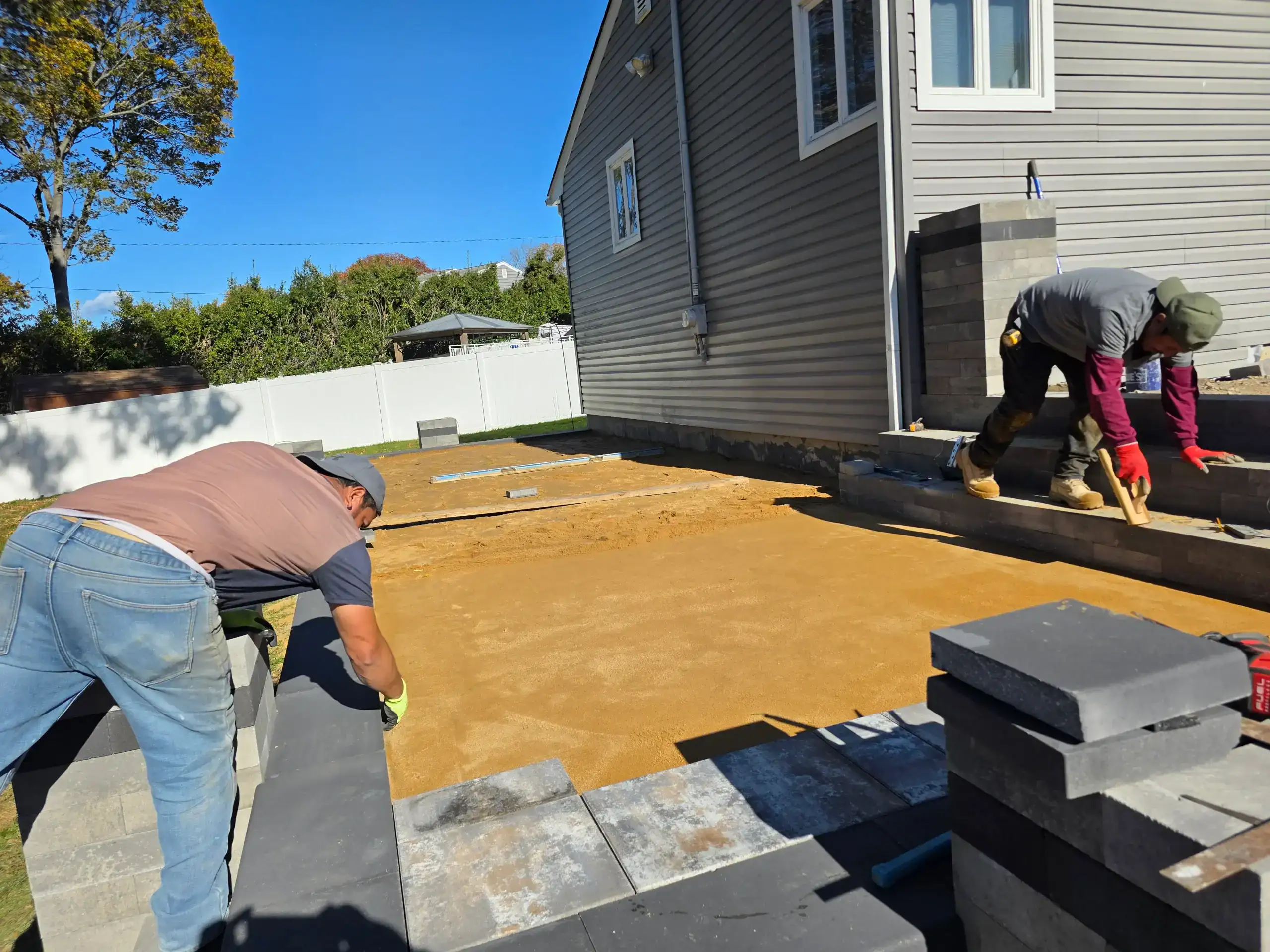
The base preparation is where budget contractors save money at your expense. Proper installation requires excavating deep enough to remove unstable soil, installing 6 to 8 inches of compacted gravel in layers, and grading for drainage. Skip this step, and you’ll see settling, cracking, and water damage within the first few years.
Suffolk County’s sandy soil presents specific challenges. Unlike clay-heavy soils that provide stable support, our sandy conditions require deeper excavation and proper compaction techniques to prevent shifting. We’ve been working with Long Island soil conditions for over 25 years, and we factor these requirements into our pricing. Contractors who don’t often leave you with a driveway that develops low spots and drainage problems.
Asphalt requires maintenance to reach its full lifespan. You’ll need sealcoating every 2 to 3 years at $0.15 to $0.30 per square foot. For a 600-square-foot driveway, that’s $90 to $180 per application. Factor these ongoing costs into your total investment when comparing materials.
With proper installation and regular maintenance, asphalt driveways in Suffolk County last 15 to 20 years. The key phrase there is “proper installation.” A budget job might look fine initially but fail in 5 to 7 years, requiring complete replacement.
Concrete costs more upfront than asphalt—typically $8 to $18 per square foot installed in Suffolk County. For a standard 600-square-foot driveway, expect to pay $4,800 to $10,800. Stamped or decorative concrete pushes costs even higher, sometimes reaching $12 to $25 per square foot.
The higher initial cost comes with some advantages. Concrete requires less ongoing maintenance than asphalt. You won’t need regular sealcoating, though occasional cleaning and degreasing help maintain appearance. A well-installed concrete driveway can last 25 to 30 years in moderate climates.
Here’s the problem: Suffolk County isn’t a moderate climate. Our freeze-thaw cycles are concrete’s worst enemy. Water seeps into tiny cracks, freezes, expands, and creates larger cracks. This happens repeatedly throughout winter, sometimes multiple times per week. Concrete’s rigidity means it can’t flex with these temperature changes like asphalt does.
Salt damage accelerates the deterioration. Road salt and de-icers used during winter break down concrete surfaces over time, creating pitting and surface degradation. Many Suffolk County homeowners who chose concrete learned this lesson the hard way, watching their investment crack and spall within a few years.
Concrete repairs are more expensive and more visible than asphalt repairs. When concrete cracks, you can’t just patch it seamlessly. The repairs remain obvious, and matching the color and texture of existing concrete is difficult. Replacement sections rarely blend perfectly with the original installation.
If you’re considering concrete, understand that the 25 to 30-year lifespan applies to areas without harsh freeze-thaw cycles. In Suffolk County, you’ll likely see problems sooner. The material works better in hot, dry climates where it can take advantage of its heat-reflective properties and durability under consistent conditions.
The installation process takes longer too. Concrete needs 7 to 10 days to cure before you can drive on it, compared to 3 to 5 days for asphalt. If you need quick access to your driveway, this extended timeline matters.
For Suffolk County specifically, concrete makes sense in limited situations: if you absolutely need the aesthetic options it provides, if you’re willing to accept potential freeze-thaw damage as part of the trade-off, or if your property has specific drainage advantages that minimize water infiltration. Otherwise, asphalt or pavers typically offer better long-term value for our climate.
Want live answers?
Connect with a Corsino Construction expert for fast, friendly support.
The quote you receive depends on more than just square footage and material choice. Several factors specific to your property and Suffolk County conditions influence the final price.
Driveway size is the obvious starting point. Larger driveways require more materials and labor, increasing total cost. Most Long Island driveways range from 400 to 800 square feet. A single-car driveway around 300 square feet costs less than a two-car driveway at 600 square feet, which costs less than extended driveways with turnaround areas at 1,000+ square feet.
Site preparation varies significantly between properties. If you have an existing driveway, removal and disposal add $1 to $3 per square foot depending on material type and thickness. Concrete removal costs more than asphalt due to weight and disposal fees. Some contractors include removal in their base quote; others charge it separately.
Labor typically accounts for 40 to 50 percent of your total driveway cost. In Suffolk County, labor rates run $5 to $7 per square foot for asphalt installation, though complex projects requiring significant grading or drainage work cost more.
The installation process involves multiple steps, each requiring specific skills and equipment. We use excavation equipment, compaction machinery, asphalt pavers or concrete mixers, and finishing tools. Companies that own their equipment rather than renting it often provide more consistent quality because they’re not rushing to return rentals or working around availability schedules.
Experienced contractors charge more than new companies or unlicensed crews, but that premium buys you expertise in handling Suffolk County’s specific challenges. We understand our sandy soil composition, know how deep to excavate for local frost lines, and plan drainage to account for our high water table and coastal storms.
Site accessibility affects labor costs too. If your driveway is easy to reach with standard equipment, costs stay lower. Narrow lots, overhanging trees, tight turns, or other obstacles that require smaller equipment or more manual labor increase the price. Some properties require hand-raking and finishing instead of machine work, which takes more time.
Grading and drainage work add to labor costs but prevent expensive problems later. Proper grading directs water away from your driveway surface and foundation. In Suffolk County, where we get heavy rain and coastal moisture, this step isn’t optional—it’s how you avoid standing water, frost heave, and premature driveway failure.
Timing influences pricing in some cases. Spring, summer, and early fall represent peak season for paving work. Demand is high, and some contractors charge premium rates during these months. Late fall or early spring might offer slight savings, though weather conditions can limit work options and extend project timelines.
The contractor’s business model matters more than most homeowners realize. Companies using licensed in-house professionals typically charge more than those relying on subcontractors, but you get direct accountability and consistent quality. When problems arise, you’re dealing with the same company that did the work, not trying to track down a subcontractor who’s moved on to other jobs.
Get detailed written estimates from at least three contractors. The estimate should specify excavation depth, base material type and thickness, asphalt or concrete thickness, drainage provisions, timeline, and warranty terms. Vague quotes that don’t break down these details often hide corners that will be cut.
Watch for red flags: contractors who pressure you to decide immediately, those who offer suspiciously low prices compared to other quotes, anyone requesting full payment upfront, or companies that can’t provide proof of licensing and insurance. These warning signs often precede the kind of problems that end up costing you far more than you “saved” on the initial quote.
The final bill shouldn’t surprise you if your contractor is transparent, but several costs catch homeowners off guard when they’re not clearly discussed upfront.
Permits represent one common surprise. Many Suffolk County towns require permits for driveway work, particularly if you’re expanding the driveway footprint, changing drainage patterns, or connecting to county roads. Permit fees typically range from $50 to $500 depending on your municipality and project scope. We handle permit applications and include these costs in our quote. Budget operations skip permits entirely, leaving you liable for violations discovered later.
Drainage solutions add cost but prevent disaster. If your property has poor drainage or a high water table, you might need French drains, channel drains, or significant regrading. These additions can add $500 to $3,000 to your project but protect your investment from water damage that would cost far more to repair.
Utility relocation sometimes becomes necessary. If sprinkler systems, electrical lines, or other utilities run through your driveway area, moving them adds $500 to $5,000 depending on complexity. This should be identified during the initial site assessment, not discovered mid-project.
Edge restraints and borders increase costs but improve longevity. For paver driveways, proper edge restraints prevent spreading and shifting. For asphalt driveways, Belgian block or concrete borders provide clean edges and structural support. These features add $3 to $8 per linear foot but help the entire driveway last longer.
Soil conditions occasionally reveal surprises during excavation. Soft spots, underground springs, or areas requiring additional base material can increase costs. Honest contractors discuss these issues when discovered and explain why additional work is necessary. Dishonest ones either ignore the problem or use it as an opportunity to inflate charges.
Cleanup and disposal should be included in your quote but verify this. Some contractors charge separately for hauling away old materials or cleaning up the job site. You shouldn’t have piles of old asphalt or dirt left in your yard after the crew leaves.
Maintenance costs factor into long-term budgeting. Asphalt requires sealcoating every 2 to 3 years. Concrete needs occasional cleaning and may require crack repairs. Pavers need joint sand replenishment and occasional individual paver replacement. Factor these ongoing costs into your material decision.
Budget for the unexpected by adding 10 to 15 percent to your estimated project cost. This buffer covers minor surprises without derailing your finances. If you don’t need it, great. If excavation reveals issues requiring additional base work, you’re prepared.
Ask contractors explicitly about what’s included and what costs extra. The conversation should cover removal and disposal, permits, drainage work, edge restraints, cleanup, and warranty coverage. Any contractor unwilling to detail these items in writing isn’t someone you want working on your property.
Driveway paving costs in Suffolk County vary widely, but the difference between a smart investment and an expensive mistake comes down to understanding what you’re actually paying for. The lowest quote rarely delivers the best value when it skips excavation depth, base preparation, proper drainage, or uses substandard materials.
Focus on contractors who explain the “why” behind their pricing, provide detailed written estimates, handle permits and drainage properly, and use licensed in-house professionals. These factors matter more than shaving a few hundred dollars off the initial quote.
Your driveway should last 15 to 20 years or more with proper installation. That only happens when the work accounts for Suffolk County’s freeze-thaw cycles, sandy soil, and coastal moisture from the start. When you’re ready to move forward with a driveway that’s built right the first time, we bring 25+ years of experience, fixed transparent pricing, and the kind of installation quality that prevents the problems other contractors create.
Article details:
Share:
Continue learning: