Decks, patios, driveways, permits — here's what Suffolk County homeowners actually need to know before starting an outdoor project.
Share:
Summary:
Most homeowners in Suffolk County don’t start an outdoor project feeling confident. They start it feeling overwhelmed — by cost estimates that range from $4,000 to $40,000 for what sounds like the same job, by contractors who don’t return calls, and by a permit process that nobody explains clearly. If you’ve been searching for straight answers and keep landing on pages that tell you to “transform your backyard into an oasis,” you’re in the right place. This guide covers real costs, real tradeoffs, and the local specifics — Suffolk County soil conditions, town-level permitting, coastal material requirements — that actually matter when you’re planning an outdoor project here.
The honest answer is that neither a deck nor a patio is always cheaper — it depends on materials, scope, and what your yard actually requires. A basic poured concrete patio runs $12–$25 per square foot installed in Suffolk County, making it the most affordable option upfront. A pressure-treated wood deck runs roughly $18–$38 per square foot installed, and a composite deck climbs to $35–$70 per square foot.
Where it gets interesting is the long-term math. Wood decks need staining or sealing every two to three years. Composite decks cost more upfront but hold up for 25+ years with minimal maintenance — which matters when you’re dealing with Long Island’s salt air and freeze-thaw winters. A paver patio sits in the middle: $30–$45 per square foot professionally installed, durable, and low-maintenance if the base is done right.
At resale, a wood deck recoups roughly 94.9% of its cost, composite around 88.5%, and a paver patio around 69% — according to Zonda’s 2025 Cost vs. Value Report. The gap in percentages sounds significant, but the dollar amounts often tell a different story depending on what you spent.

For a straight apples-to-apples comparison on a 12×16 footprint, a poured concrete patio typically runs $2,800–$4,600 installed in Suffolk County. A pressure-treated wood deck of the same size runs closer to $6,800–$9,800. So yes — at the entry level, concrete is cheaper.
But that comparison breaks down quickly once you factor in what you’re actually getting. Concrete patios in Suffolk County are vulnerable to cracking and heaving if the base isn’t prepared properly. Long Island’s clay soil drains poorly, and the freeze-thaw cycles we get every winter — where the ground freezes, expands, and thaws repeatedly — will exploit any weakness in a poured surface. A concrete patio that isn’t excavated to the right depth, with the right gravel base and proper drainage built in, can start showing damage within two or three winters.
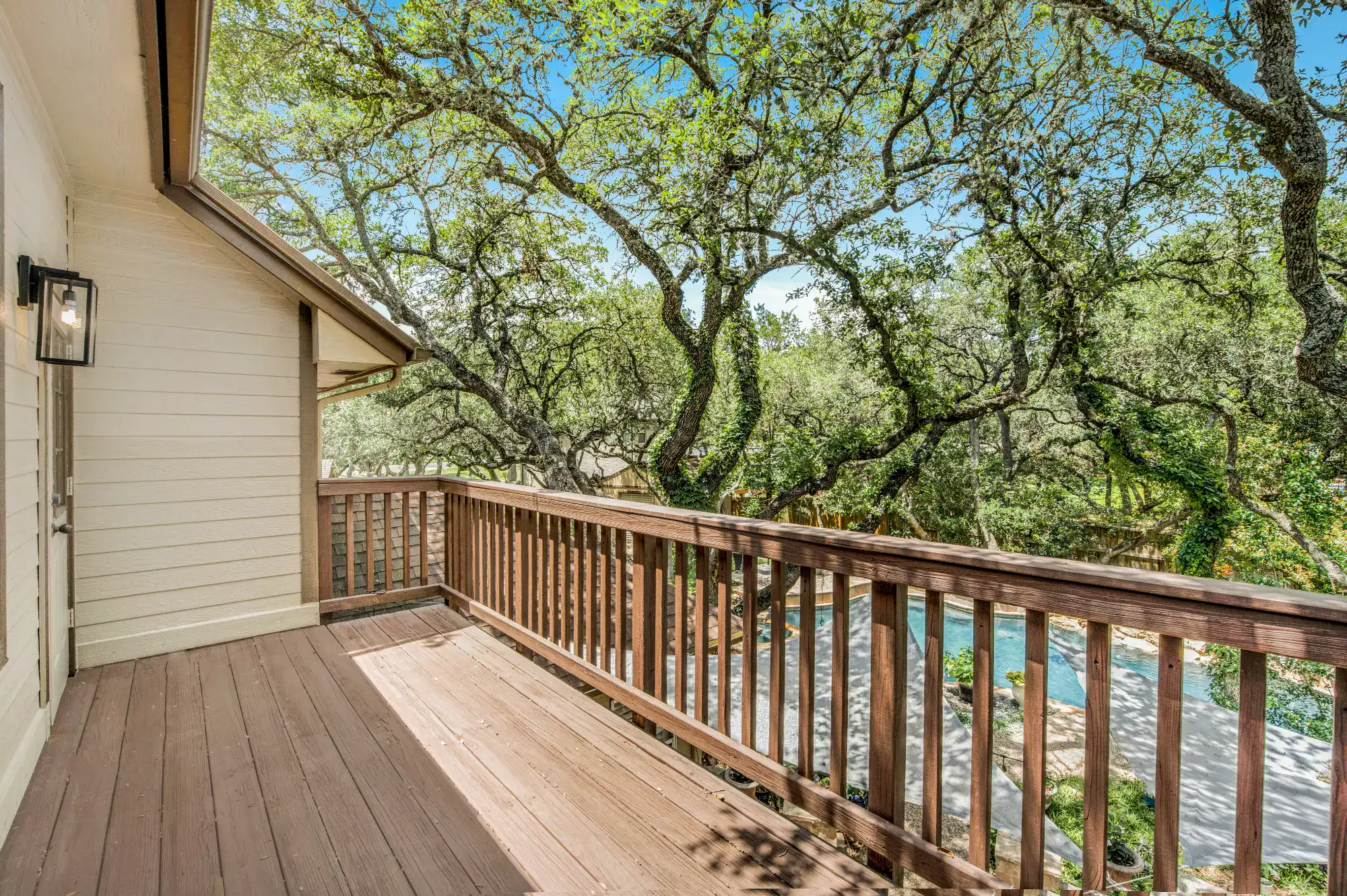
A wood deck, by contrast, doesn’t have the same vulnerability to ground movement because it’s elevated on footings. But it has its own Suffolk County-specific challenge: coastal salt air accelerates the corrosion of fasteners and the degradation of certain wood species. If you’re in Babylon, Bay Shore, Lindenhurst, or anywhere along the South Shore, the hardware holding your deck together needs to be stainless steel or hot-dipped galvanized — not the standard fasteners a less experienced contractor might use.
The real question isn’t which is cheaper to build. It’s which will cost you less over the ten years after you build it. That’s where the honest conversation has to start, and it’s why material selection and proper installation technique matter so much in this specific market.
If you want something that holds up in Suffolk County without demanding your attention every spring, composite decking and interlocking pavers are the two options most worth considering. Composite decking — brands like Trex, TimberTech, and Azek are the standard quality options used by established Long Island builders — won’t rot, won’t splinter, and doesn’t need to be sealed. The surface holds its color and texture for decades. The tradeoff is cost: you’re paying $35–$70 per square foot installed, compared to $18–$38 for wood.
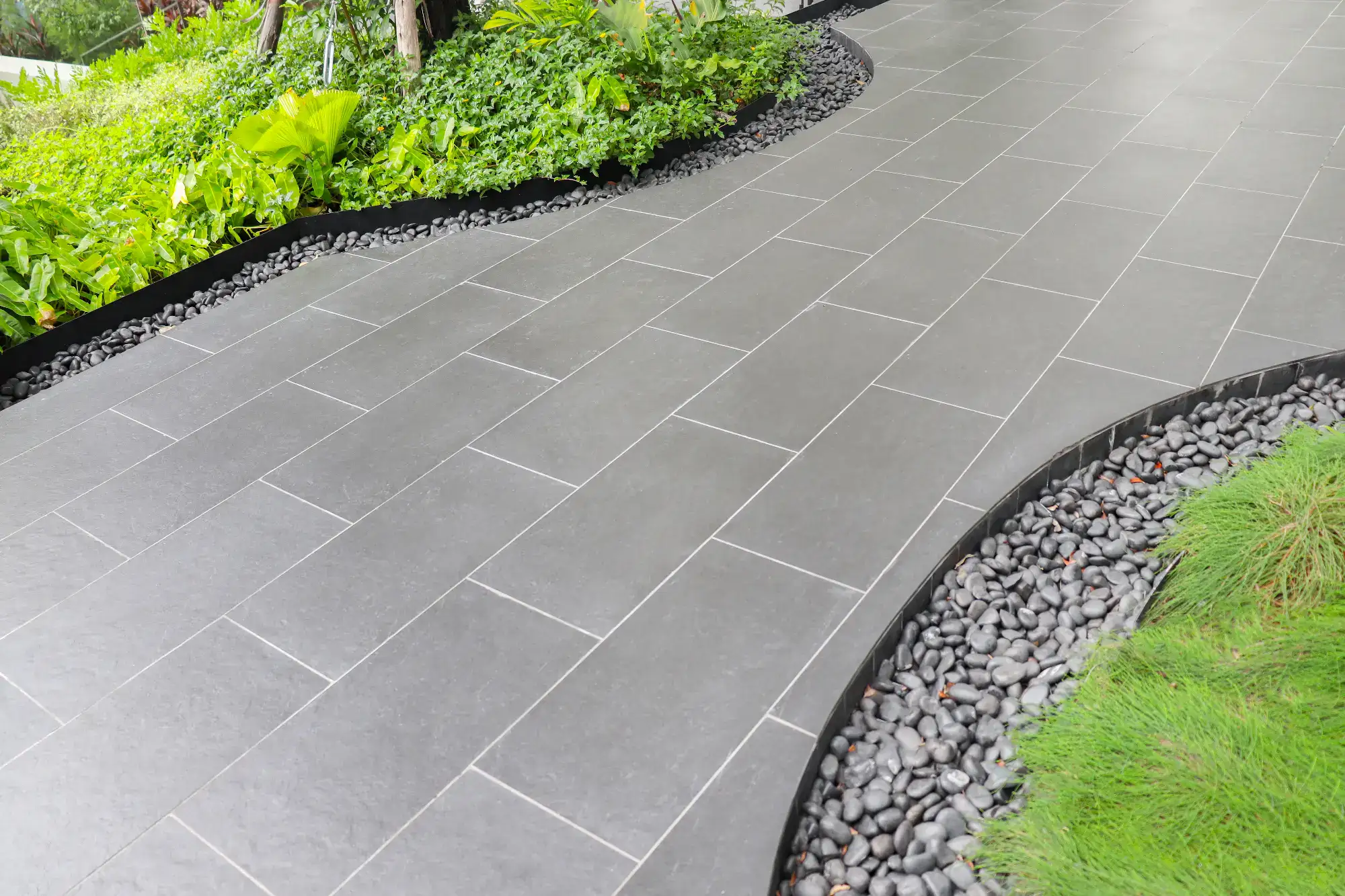
Interlocking pavers — Cambridge and Nicolock are the dominant brands in this market — offer a different kind of durability. Because individual pavers can be lifted and reset, they handle freeze-thaw movement better than poured concrete. If a section heaves or settles, it can often be repaired without replacing the entire surface. That’s a meaningful advantage in a climate like ours. Paver installation in Suffolk County runs $30–$45 per square foot professionally installed, which puts it between wood and composite decking on a cost-per-square-foot basis.
Natural stone is another option — beautiful, extremely durable, and at the higher end of the cost range ($4,800–$15,700 for a 12×16 surface depending on stone type). It requires proper base preparation just like any other surface, but when it’s done right, it’s essentially permanent. For homeowners in Southampton, East Hampton, or other East End communities where aesthetics and longevity both matter, natural stone is worth the conversation.
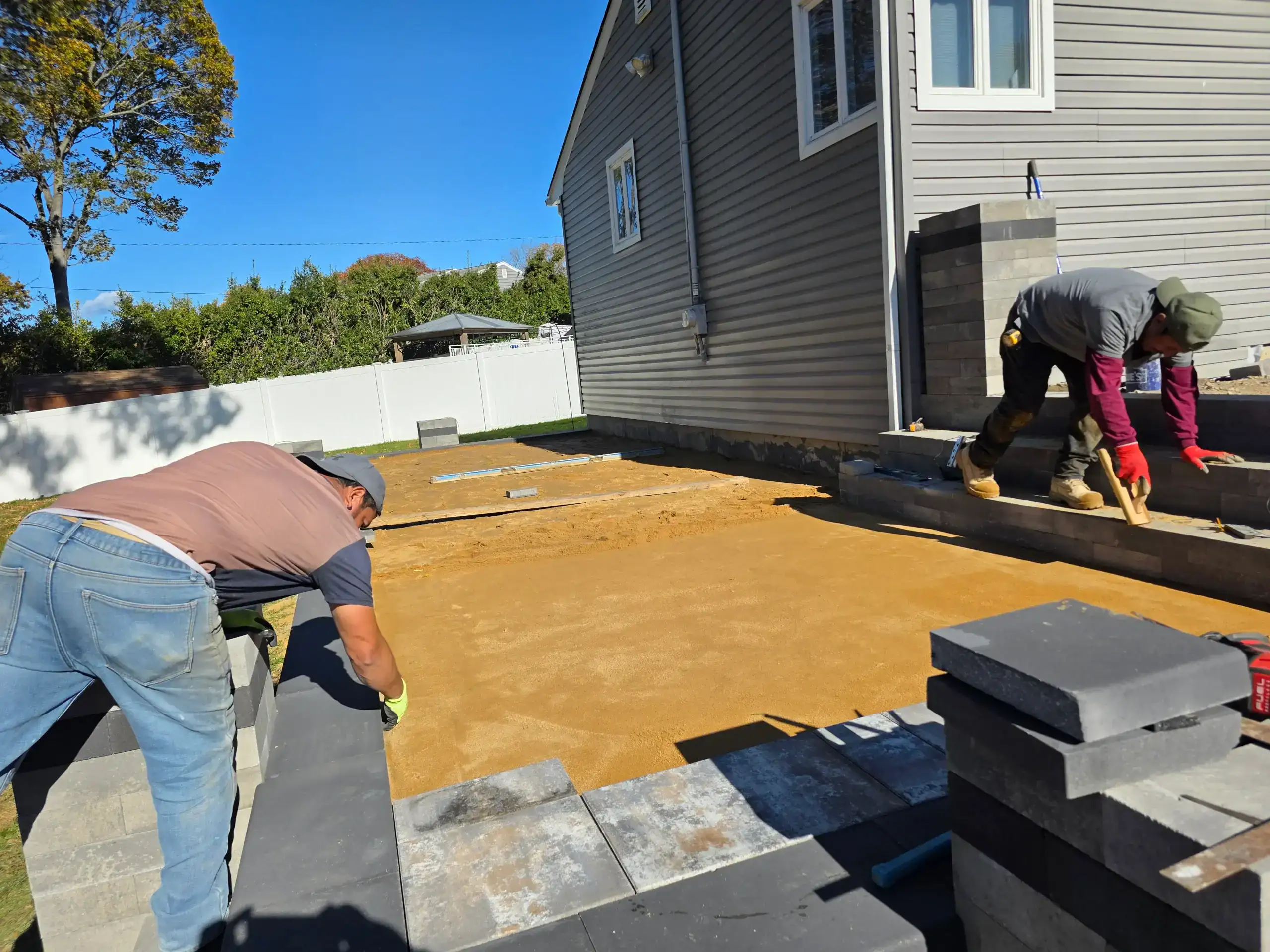
What all of these options have in common is that their long-term performance depends almost entirely on how well the base is prepared — not just the surface material itself. That’s where experience with Suffolk County’s specific soil conditions makes a real difference.
Want live answers?
Connect with a Corsino Construction expert for fast, friendly support.
Labor costs in Suffolk County run $50–$100 per hour for deck and patio work. On a per-square-foot basis, that typically translates to $15–$35 per square foot in labor alone, before materials. The total project cost — materials and labor combined — is where you get the ranges cited above: $18–$38 per square foot for a wood deck, $35–$70 for composite.
What drives the variation within those ranges is mostly complexity: multi-level decks, built-in seating or planters, custom railing systems, and integrated lighting all add to both material and labor costs. A straightforward single-level deck on a flat lot is at the lower end. A multi-level deck with a staircase, custom railings, and a pergola is at the upper end.

The most important question you can ask a contractor in Suffolk County isn’t about price — it’s about who’s actually going to show up at your house. A significant number of contractors in this market operate as general contractors who hire subcontractors for the actual work. That’s not inherently wrong, but it creates a real accountability problem: if something goes wrong, the GC points at the sub, the sub is gone, and you’re the one holding an expensive problem.
The contractors worth hiring are the ones who use their own licensed, in-house crews from start to finish. When the same people who gave you the estimate are the ones doing the work — and are accountable to the same company throughout — the quality and communication tend to be dramatically more consistent.
Beyond crew structure, look for a contractor who handles Suffolk County permits as part of the service. Permitting in this county is done at the town level, not the county level, which means the process looks different depending on whether you’re in Huntington, Islip, Brookhaven, or Babylon. Each town has its own building department, its own plan requirements, and its own review timeline. A contractor who knows how to navigate that — and who manages it for you — is worth more than one who leaves you to figure it out on your own.
Get a written, itemized estimate. Not a ballpark, not a verbal number — a written proposal that specifies materials, scope, timeline, and total cost. If the number changes after work begins, that’s a serious problem. The best contractors in this market provide fixed pricing: the number in the estimate is the number you pay.
Finally, ask about cleanup. You’re going to be living next to this job site for days or potentially weeks. A contractor who cleans up at the end of every workday makes that experience significantly more tolerable.
This is one of the most common questions we hear from Suffolk County homeowners, and the honest answer is: it depends on how much of the structure is compromised. If you’re dealing with a few soft boards, a loose railing section, or surface-level weathering, repair is often the right call. Minor repairs — replacing boards, fixing railings, re-securing loose posts — typically run $150–$800 depending on scope.
But if the structural members are involved — the joists, beams, or posts — the math changes quickly. Structural repairs can run $1,500–$5,000 or more, and at that point you’re often better off replacing the deck entirely. A rough rule of thumb: if more than 30% of the deck’s boards or structural components need attention, full replacement is usually more cost-effective than piecemeal repair.
There’s also a permit consideration. In Suffolk County, any work that involves structural modification to a deck typically triggers a permit requirement — even if you’re not adding square footage. A contractor who pulls the appropriate permits protects you from code enforcement issues down the line and from complications when you eventually sell the property. Skipping permits might save a few hundred dollars today, but an unpermitted structure can create serious problems at closing.
One more thing worth knowing: if your deck was built more than 15–20 years ago, it was likely built to older code standards. Even if the structure looks okay on the surface, it may not meet current requirements for footing depth, railing height, or load capacity. A proper inspection before deciding to repair or replace is time well spent.
The outdoor projects that hold up longest in Suffolk County — and add the most value — are the ones where the homeowner asked the right questions before signing anything. Who’s actually doing the work? Is the price fixed? Are permits included? What happens if something goes wrong?
Those aren’t difficult questions. But the answers tell you almost everything you need to know about whether a contractor is worth hiring.
We’ve been building decks, patios, driveways, and outdoor living spaces for Suffolk County homeowners since 2000. Our crews are in-house and licensed, our pricing is fixed, and we handle all permits through the appropriate town building departments — whether that’s Brookhaven, Islip, Huntington, or anywhere else in the county. If you’re ready to get a real number for your project, reach out and we’ll get back to you within 24–48 hours.
Article details:
Share:
Continue learning: