Replacing your driveway in Suffolk County? Here's what the national guides won't tell you about asphalt, concrete, and pavers in a freeze-thaw climate.
Share:
Summary:
You’ve probably already read a few articles on this. Asphalt is cheaper. Concrete lasts longer. Both have pros and cons. Thanks — very helpful.
What those guides skip is the part that actually matters for homeowners in Suffolk County: Long Island’s climate is not a generic cold-weather market. The freeze-thaw pattern here, the coastal soil conditions, the salt air coming off the Sound and the Atlantic — all of it changes how each material performs over time. And none of it shows up in a national comparison chart.
So let’s talk about what actually holds up here, what it costs, and — maybe most importantly — why the contractor you hire matters just as much as the material you choose.
The standard pitch goes like this: asphalt costs less to install, concrete costs less to maintain. That’s broadly true — but it glosses over the conditions that make Long Island its own category entirely.
Suffolk County sits in a maritime climate. Winters here don’t stay deeply cold for months at a time the way upstate New York does. Instead, temperatures hover right around 32°F and swing back and forth repeatedly throughout the season. That oscillation pattern — not sustained cold — is what does the damage.
Water works its way into small surface cracks during warmer days, freezes overnight, expands with pressure that can reach 30,000 pounds per square inch, and widens those cracks with every cycle. The county sees roughly 20 to 30 of these freeze-thaw cycles per winter. That’s more than most of New York State, and it’s the single most important factor in choosing a driveway material here.
Asphalt has a flexibility advantage that concrete simply doesn’t. Because it’s a petroleum-based material, it can absorb some of the stress from ground movement and temperature swings without cracking the way a rigid concrete slab does. That flexibility makes it genuinely well-suited to Long Island’s freeze-thaw pattern — which is why asphalt driveways are so common across Suffolk County neighborhoods from Coram to Commack to Babylon.
On Long Island, a properly installed asphalt driveway typically lasts 15 to 20 years. Installation runs $7 to $15 per square foot, putting a standard two-car driveway somewhere between $4,200 and $9,000 depending on size, site conditions, and prep work required. Those are local figures — not national averages.
The trade-off is maintenance. Asphalt needs to be sealcoated every two to three years to protect against oxidation, moisture penetration, and the salt that comes with Long Island winters — both from road maintenance on routes like the LIE and Sunrise Highway, and from coastal air exposure. Each sealcoating application runs roughly $300 to $600 for a standard driveway.
Over a 25-year period, that maintenance adds up to $3,000 to $5,000 on top of your original installation cost. Factor in eventual resurfacing or full replacement, and the long-term price of an asphalt driveway is higher than the upfront number suggests.
For homeowners who want a durable, functional driveway at a lower entry cost and are willing to keep up with the maintenance schedule, asphalt performs well here. The problem is when people choose it based on the upfront price alone and then skip the sealcoating — that’s when you see driveways crumbling after eight or ten years instead of lasting twenty.
Concrete is the more durable material in stable climates. In Suffolk County, it’s more complicated.
A concrete slab doesn’t flex. When the ground beneath it shifts — and in the sandy coastal soils common across southern and eastern Suffolk County, it will — or when freeze-thaw pressure builds beneath the surface, concrete cracks rather than bends. That’s not a flaw in the material itself; it’s a function of how rigid surfaces interact with the specific conditions here.
Concrete installed with the right mix design and proper base preparation can perform very well. The problem is that “right mix design” means something specific in this climate: a minimum 4,000 PSI air-entrained concrete mix, which creates microscopic air pockets that give ice expansion somewhere to go rather than forcing it into the surface. Standard 3,000 PSI concrete — the default in many markets — is more vulnerable to freeze-thaw damage here.
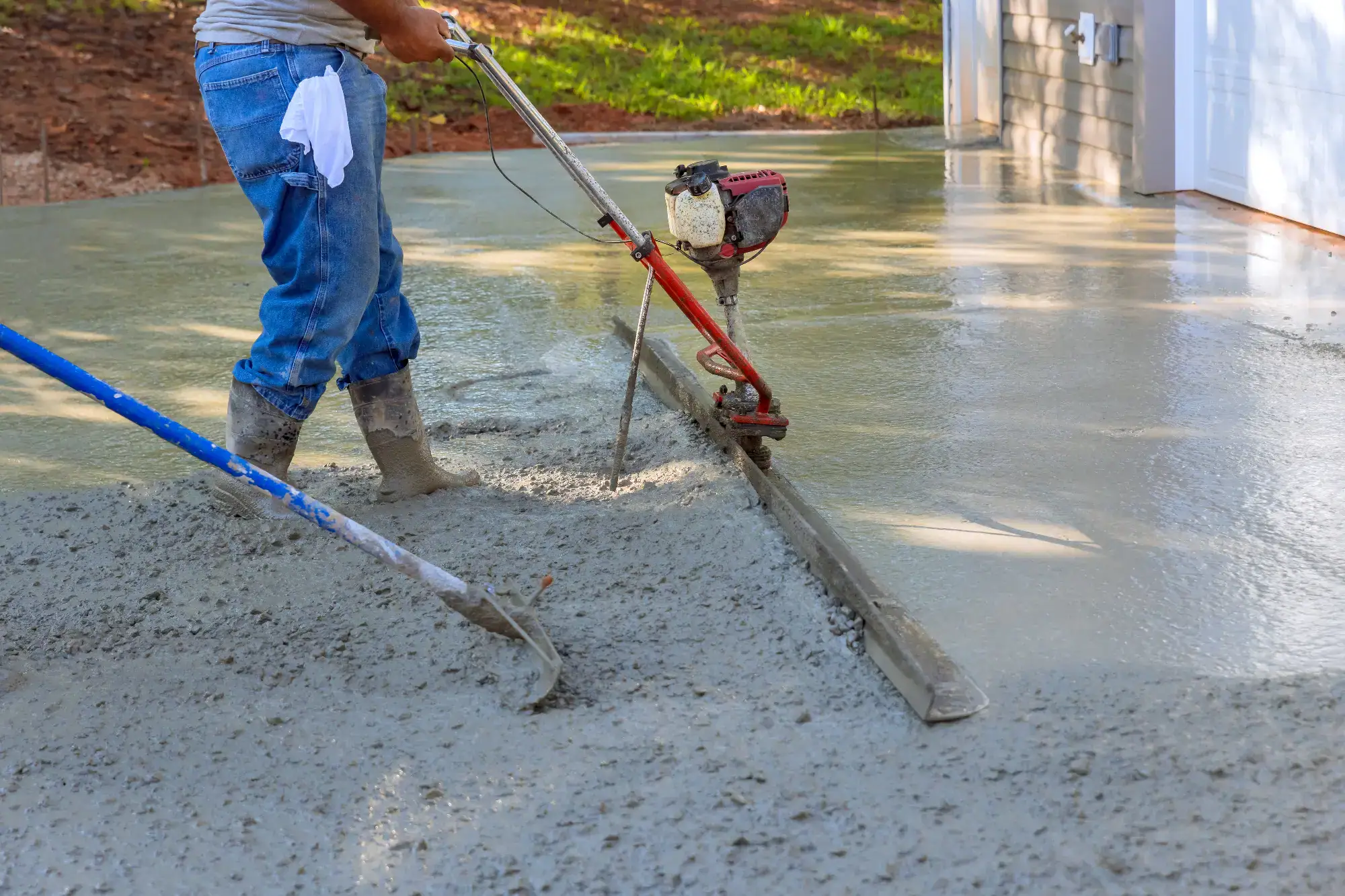
On Long Island, concrete driveway installation runs $12 to $25 per square foot, or roughly $7,200 to $15,000 for a standard two-car driveway. It lasts 25 to 40 years with proper installation and maintenance. Maintenance is less frequent than asphalt — sealing every two to three years is recommended — but when concrete does crack and needs repair, those repairs average $828 to $2,819 depending on scope.
De-icing chemicals — calcium chloride, rock salt — are harder on concrete than on asphalt. If you’re in a part of Suffolk County that gets significant road salt runoff, or if you use de-icers on your own surface, unsealed concrete takes that damage faster. Sealed regularly and installed correctly, concrete holds up well. But it requires more upfront investment and more attention to installation quality than asphalt does to reach its potential lifespan.
Want live answers?
Connect with a Corsino Construction expert for fast, friendly support.
Pavers don’t come up in most quick comparison searches, but they deserve a place in this conversation — especially for homeowners in Suffolk County who are thinking about the long game.
Paver driveways run $20 to $35 per square foot installed on Long Island, which puts a standard two-car driveway somewhere between $12,000 and $21,000. That upfront number stops a lot of people right there. But the lifespan changes the math: a well-installed paver driveway lasts 30 to 50-plus years, and individual pavers can be replaced without disturbing the rest of the surface — a significant advantage when freeze-thaw cycles or tree roots cause localized damage.
When you run the cost-per-year numbers, a $6,000 asphalt driveway replaced at year 15 works out to roughly $400 per year. A $15,000 paver driveway lasting 40 years comes out to about $375 per year. For homeowners who plan to stay in their home long-term, pavers can actually be the more economical option over time — and they add curb appeal that holds up well in a market where Suffolk County’s median home value sits at $660,000.
There isn’t one right answer for every homeowner in Suffolk County, but there are a few questions that cut through the noise quickly.
How long do you plan to stay in the house? If you’re planning to sell within five to seven years, asphalt gives you a functional, presentable driveway at the lowest entry cost. If you’re staying for twenty years or more, the long-term cost and durability picture shifts significantly toward concrete or pavers. A 5 to 10 percent increase in home value on a $660,000 Suffolk County property represents $33,000 to $66,000 — which reframes what a $12,000 paver driveway actually costs in context.
What are your soil conditions? Homeowners in coastal and southern parts of the county — Shirley, Holbrook, Westhampton Beach, Southampton — tend to have sandier soil that shifts and compacts, making base preparation especially critical. Inland areas like Huntington, Commack, and Coram often have clay-heavy soil that holds water at the driveway base, increasing the risk of freeze-thaw damage from below. A contractor who knows your specific town’s soil conditions and drainage patterns is more valuable than one who applies the same approach everywhere.
What’s your maintenance tolerance? Asphalt demands a consistent sealcoating schedule — skip it for a few years and you’ll feel it in the driveway’s lifespan. Concrete is lower maintenance but less forgiving when damage does occur. Pavers require the least ongoing attention and offer the most flexibility for repairs.
Here’s the part most comparison guides skip entirely: the single most common cause of early driveway failure in Suffolk County isn’t the wrong material. It’s poor installation.
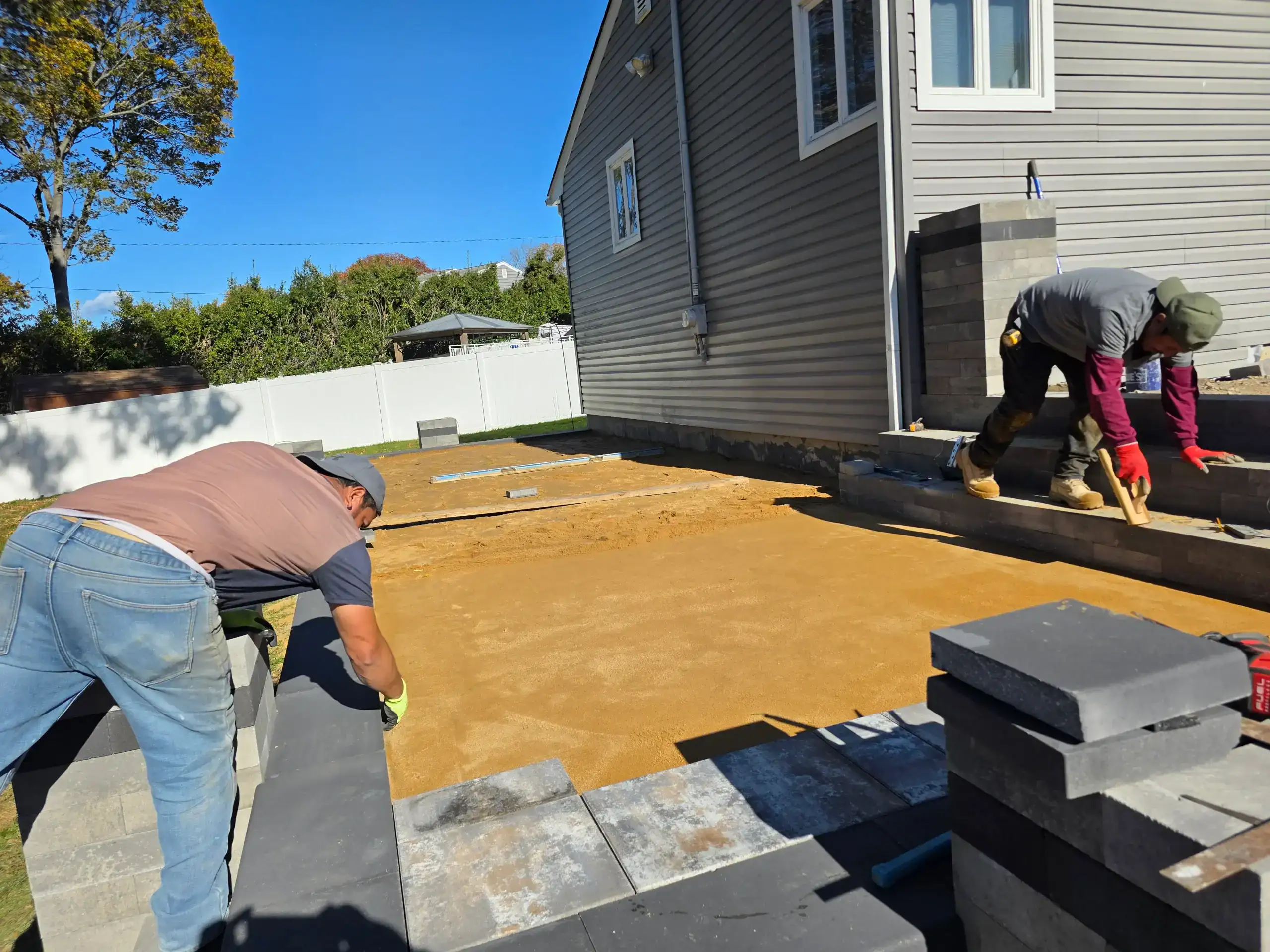
Inadequate base depth. Improper drainage grading. Asphalt laid too thin. Concrete poured with the wrong mix for freeze-thaw conditions. These are the shortcuts that turn a 20-year driveway into a 7-year headache — and they happen regardless of whether you chose asphalt or concrete. You can make the “right” material choice and still end up with a cracked, heaving surface in five years if the crew cut corners on prep work.
This is why the contractor selection conversation belongs inside the material comparison conversation, not after it. A few things worth knowing before you hire anyone for a driveway project in Suffolk County: Are they licensed and insured for home improvement work in New York State? Do they use their own crews, or do they subcontract the work to whoever’s available? Will they provide a written, itemized estimate that doesn’t change once work begins? Do they handle permits — because depending on your municipality, a driveway replacement may require one, and skipping that step creates problems at resale?
The permit question alone is worth asking directly. Suffolk County includes nine separate towns — Huntington, Babylon, Brookhaven, Islip, Smithtown, Southampton, East Hampton, Riverhead, and Shelter Island — each with its own requirements. A contractor who works across all of them regularly knows which projects trigger permit requirements and handles that process as part of the job.
We’ve been doing this work in Suffolk County since 2000. We use in-house crews — not subcontractors — because consistent quality requires consistent people. Our estimates are written, itemized, and don’t change once you’ve approved them. We handle permits across every municipality we work in, and we include those costs in the estimate so there are no surprises.
Asphalt, concrete, or pavers — the right choice depends on your timeline, your soil conditions, your budget, and how much ongoing maintenance you’re willing to do. What it doesn’t depend on is the national average or the generic advice that treats Long Island like every other cold-weather market.
Suffolk County’s freeze-thaw pattern, coastal soil conditions, and salt exposure make this a specific conversation. The material matters. The installation matters more. And the contractor who does the work ties both of those together.
If you’re ready to replace your driveway and want a straight answer about what makes sense for your property, reach out to Corsino Construction Corp. We’ll take a look at your site, give you an honest assessment, and get you a written estimate — no pressure, no surprises, and a callback within 24 to 48 hours.
Article details:
Share:
Continue learning: