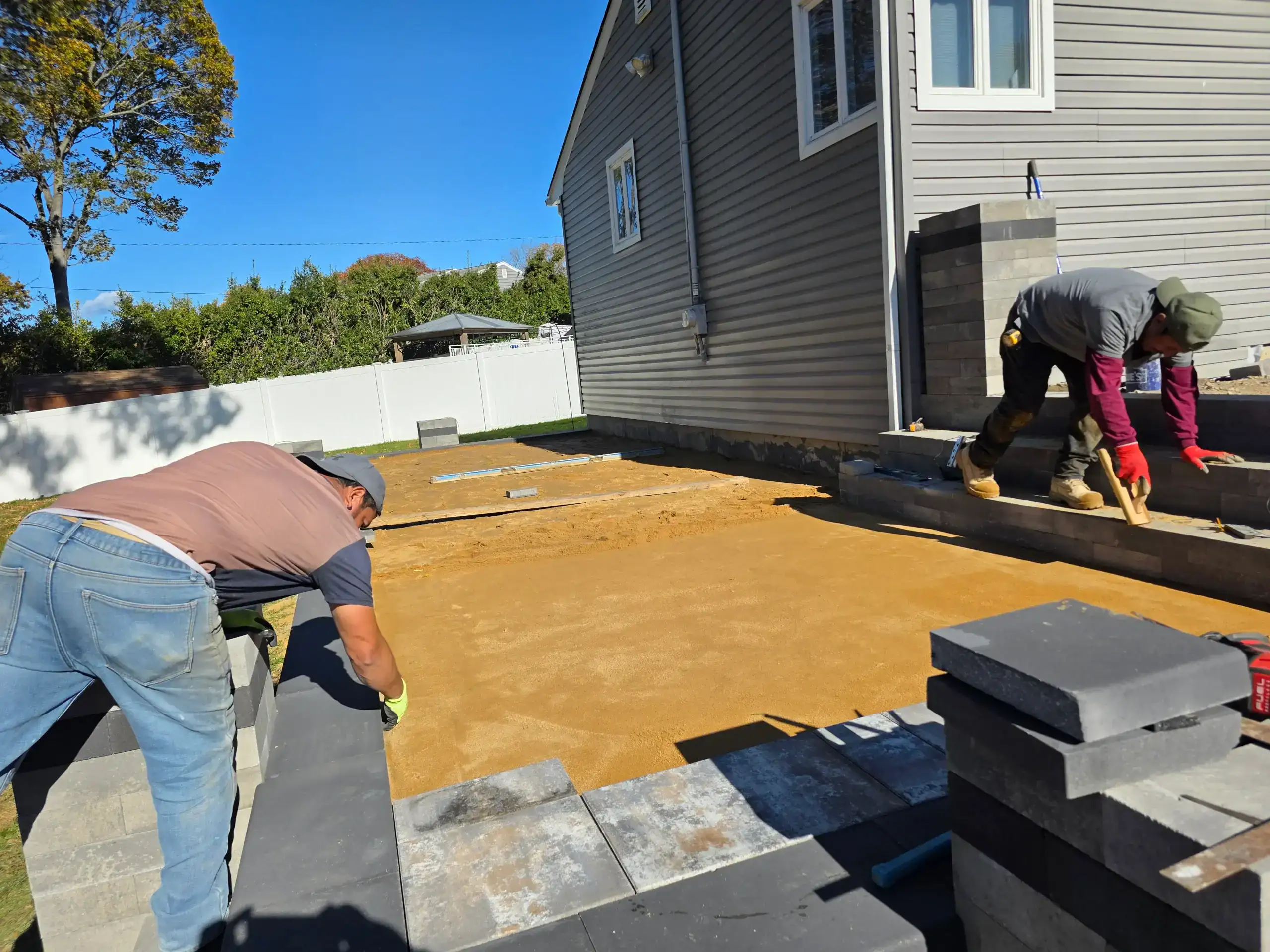
Before you sign anything or hand over a deposit, here are the contractor interview questions Suffolk County homeowners wish they'd asked sooner.
Share:

Summary:
You’ve decided to renovate. Maybe it’s the kitchen, maybe a bathroom, maybe something bigger. Either way, you’re about to invite someone into your home, hand them a significant amount of money, and trust them to deliver. That’s a lot of faith to extend to someone you just met.
The good news is that a few well-placed questions — asked before you sign anything — can tell you almost everything you need to know. Not just whether a general contractor is technically qualified, but whether they’re the kind of person who shows up, communicates, and finishes what they start.
Here’s how to run that conversation.
Most homeowners already know to ask about price and timeline. What they don’t always know is how to read the answers — or which questions cut through the sales pitch and get to the truth.
The goal here isn’t to build a long checklist. It’s to understand what separates a contractor who will protect your home and your budget from one who will drain both. The questions below are the ones that matter most, and the answers will tell you more than any glossy portfolio ever could.

The first thing to establish — before anything else — is whether the contractor is legally authorized to work on your home. In Suffolk County, NY, that means holding a valid Home Improvement Contractor license issued by the Suffolk County Department of Labor, Licensing & Consumer Affairs. This isn’t a formality. It’s a written exam, a background check, and a requirement to carry at least $500,000 in general liability insurance. Not everyone who calls themselves a contractor has done it.
Ask directly: “Can you give me your Suffolk County license number so I can verify it?” Any legitimate contractor will hand it over without hesitation. If there’s a pause, a dodge, or a reason why they can’t — that’s your answer.
Beyond licensing, ask for a certificate of general liability insurance and a workers’ compensation certificate before work begins. The workers’ comp piece matters more than people realize. If someone gets hurt on your property and the contractor doesn’t carry it, you could be on the hook. Suffolk County fines unlicensed contractors up to $750 for a first violation, but the financial exposure to you as the homeowner can be far greater.
One more thing worth asking: are you licensed to work in my specific town? East Hampton, Southampton, and Shelter Island require their own contractor licenses on top of the county-level credential. If your project is in one of those towns, a county license alone isn’t enough.
New York does not have a single statewide home improvement license — licensing is handled at the county and city level. A contractor licensed in Nassau County is not automatically licensed to work in Suffolk County, NY. Make sure the credential matches the location.
The single most common complaint homeowners have about contractors isn’t the quality of the work — it’s the price changing after the work has started. You agreed to one number, and somehow the final bill is 30% higher. It’s not always fraud. Sometimes it’s just a vague estimate that left a lot of room for interpretation. Either way, it costs you.
The question to ask here is simple: “Is this a fixed-price estimate, or is it an estimate that can change?” There’s a real difference. A fixed-price contract locks in the total before work begins. A cost-plus or open-ended estimate does not. Reputable contractors who know their trade well enough to give you a fixed number will do so. Those who hedge with “it depends” on everything may be covering for uncertainty — or worse, leaving themselves room to add costs once you’re committed.
Ask how change orders work, too. Unexpected things do happen during renovation — especially in Suffolk County, NY, where a large portion of the housing stock predates 1970 and surprises inside the walls are genuinely common. Old wiring, outdated plumbing, structural quirks that weren’t visible from the outside. A good contractor will explain exactly how they handle discoveries: what triggers a change order, how it gets documented, and how you approve it before any additional work proceeds. If the answer is vague, or if they suggest that changes just get folded into the final bill, that’s a problem.
On payment schedules, the Better Business Bureau is clear: never pay the full amount upfront. A reasonable initial deposit — typically around one-third of the total project cost — is standard. After that, payments should be tied to specific milestones, with the final payment held until the job is complete and you’re satisfied. A contractor who demands full payment before starting, or who insists on cash only, is waving a red flag.
Get everything in writing. Scope of work, materials, timeline, payment schedule, and warranty terms. A verbal promise is unenforceable, and “we talked about it” doesn’t hold up when something goes wrong three months in.
Want live answers?
Connect with a Corsino Construction expert for fast, friendly support.
The questions above are the ones most articles cover. These next ones are the ones that actually separate good contractors from great ones — and that most homeowners only wish they’d asked after the fact.
They’re not complicated questions. They’re just not obvious until you’ve lived through a renovation that went sideways. Ask them upfront, and you’ll know a lot more about what your experience is actually going to look like.

This is one of the most important interview questions for a contractor, and it’s almost never asked. Most homeowners assume the people who show up to do the work are the contractor’s people. That’s not always true.
Many contractors operate as project managers — they sell the job, then hand it off to subcontractors they may or may not know well. That’s not automatically a problem, but it does change the accountability structure significantly. When work is subcontracted, the homeowner is dealing with a communication chain: you talk to the contractor, the contractor talks to the sub, the sub does the work. If something goes wrong, there’s often finger-pointing between parties. If the sub doesn’t meet the standard you were sold, the contractor may not have direct leverage to fix it.
When a contractor uses in-house crews — the same licensed professionals on every job — the accountability is direct. There’s no handoff. The people who started the project are the people who finish it, and they’re all working to the same standard. If something needs to be addressed, there’s one person to call and one team responsible.
For Suffolk County, NY homeowners, this question matters even more because of the coastal and structural complexity of local renovation work. Long Island’s freeze-thaw cycles, salt-air exposure, and aging housing stock require crews who understand local conditions. A subcontractor brought in from outside the area may not have that context.
Ask plainly: “Will your own employees be doing the work, or will any of it be subcontracted?” Then ask a follow-up: “If subcontractors are used, are they licensed and insured, and will you provide their credentials?” The answers will tell you a lot about how the job will actually run.
Two questions that often get skipped, and both matter more than most homeowners realize.
On permits: ask directly whether the contractor will pull all required permits for your project. In Suffolk County, NY, most renovation work that involves structural changes, plumbing, or electrical requires a permit — bathroom remodels, kitchen renovations, room additions, and more. Each of Suffolk County’s towns has its own building department, and the permit process varies slightly depending on whether you’re in Huntington, Babylon, Brookhaven, or elsewhere.
A contractor who suggests skipping permits “to save time” or reduce cost is not doing you a favor. Unpermitted work can surface during a home sale, trigger fines, or result in the work being ordered removed entirely. When permits are pulled and inspections are completed, you have a documented record that the work was done correctly and to code. That protects you now and when you eventually sell.
We handle all permit applications and inspections as part of our service — it’s not an add-on, it’s just how the job gets done right.
On job site conditions: ask “How do you leave the job site at the end of each workday?” Living through a renovation is already disruptive. Coming home to tools scattered across your kitchen, dust coating every surface, and debris piling up in the hallway makes it significantly worse. Some contractors treat daily cleanup as optional. Others treat it as standard.
We treat it as standard. Tools get organized, debris gets removed, and work areas get secured every single day so you can use your home normally after hours. It sounds like a small thing until you’ve spent three weeks tripping over someone else’s equipment in your own house.
The questions above aren’t about being difficult or distrustful. They’re about making sure the person you hire has actually earned the job. A contractor who is licensed, uses their own crew, gives you a fixed-price written estimate, handles permits, and keeps a clean site doesn’t need to oversell you. The answers speak for themselves.
Suffolk County, NY homes are worth protecting. With median sale prices approaching $690,000 and a housing stock that carries decades of history, a renovation done right adds real value. One done wrong — with unpermitted work, cost overruns, or a crew you never vetted — can cost you far more than the project itself.
If you’re ready to have this conversation with a contractor who’s been doing this work in Suffolk County since 2000, Corsino Construction Corp is a straightforward call or message away. We’ll give you straight answers, a detailed written estimate, and a clear picture of exactly what your project will look like from start to finish.
Article details:
Share:
Continue learning: