Covered patio quotes vary wildly — and in Suffolk County, the reasons go deeper than material choice. Here's what actually drives the price.
Share:

Summary:
You’ve probably seen the range — $20 to $150 per square foot — and wondered why it’s so wide. The honest answer is that “covered patio” means something different to every contractor who quotes it. One is pricing a simple aluminum roof over an existing slab. Another is pricing a fully attached structure with permits, footings, drainage, and flashing built into the number. Neither is wrong. But if you’re comparing quotes without knowing what’s actually in them, you’re not comparing anything useful.
This post walks through what actually drives covered patio costs in Suffolk County so you can build a realistic budget — and ask the right questions before you sign anything.
The national benchmarks put a patio cover installed over an existing slab at roughly $20 to $60 per square foot. A complete covered patio built from the ground up — base, structure, and cover — runs closer to $50 to $150 per square foot depending on materials and design complexity.
Those numbers are real, but they’re national averages. In Suffolk County, you’re typically looking at the higher end of those ranges, and sometimes above them. Labor costs across Long Island are meaningfully higher than the national median — that’s just the cost of living here reflected in contractor pricing. Add material delivery costs across the island, the permit process that every Suffolk County town requires for any covered structure, and the coastal material specifications that any outdoor build near the water demands, and the gap between a national average and a Long Island reality becomes clear.

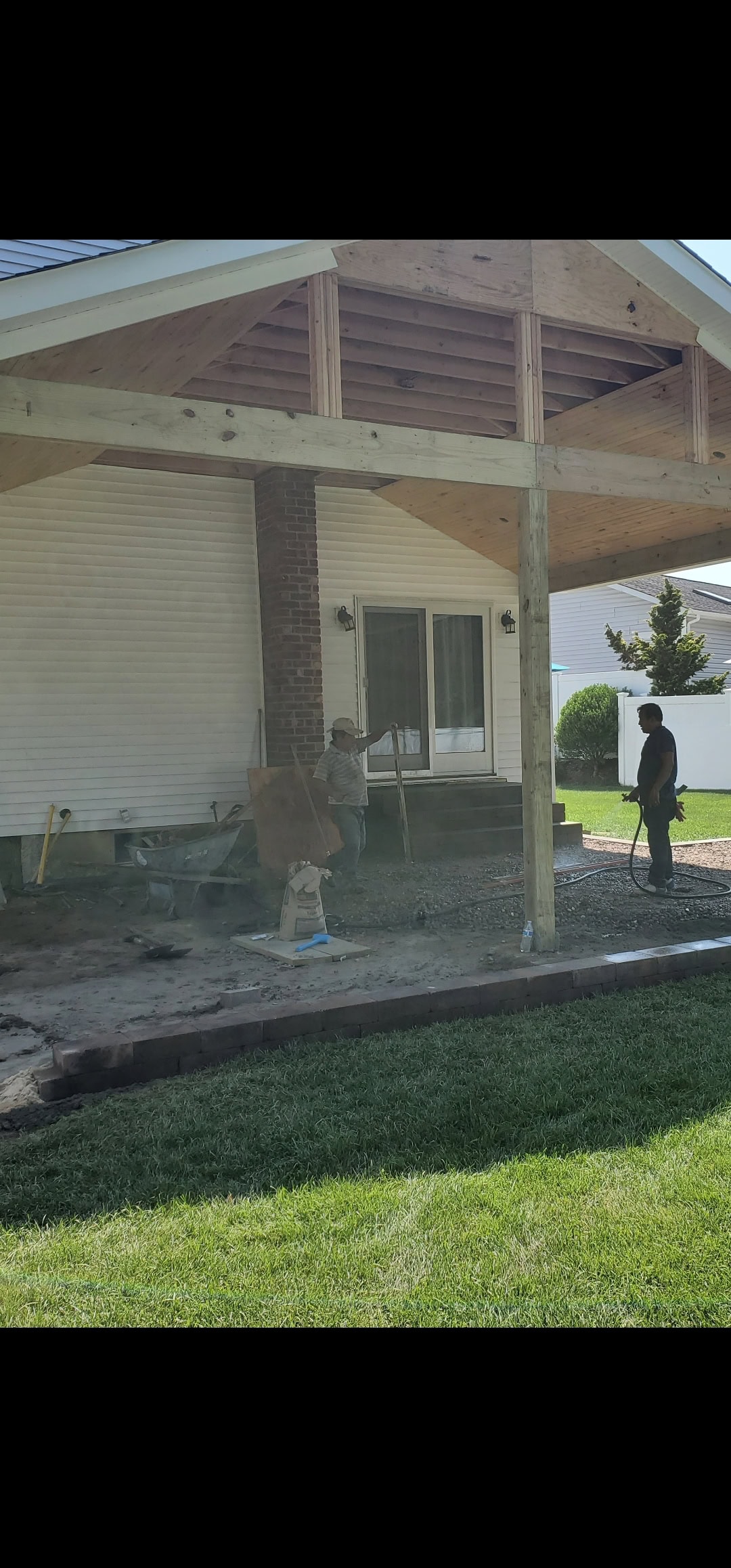
This is the distinction that catches more homeowners off guard than any other. A freestanding covered patio — one that stands independently in your yard — is structurally simpler. It needs proper footings, a frame, and a roof, but it doesn’t interact with your home’s existing structure.
An attached covered patio ties directly into your home’s wall or roofline. That connection changes everything about how the project is scoped, permitted, and priced. When a cover is attached to the house, we install a ledger board into the home’s framing, integrate proper flashing where the new roof meets the existing exterior, and ensure the connection doesn’t create a water infiltration point. Done right, this is a multi-step process that involves structural assessment, waterproofing details, and — in most Suffolk County towns — a more involved permit application than a freestanding structure would require.
The cost premium for an attached cover over a freestanding one isn’t dramatic in percentage terms, but it’s real. You’re paying for the complexity of that connection, the flashing and waterproofing work, and the additional permit documentation. What you’re getting in return is a structure that feels like part of the house — not something sitting next to it.
Much of Suffolk County’s housing stock was built between the 1950s and 1980s, and older homes sometimes have exterior walls or rooflines that need minor remediation before a ledger board can be properly installed. A contractor who doesn’t check this upfront may quote you for a straightforward attachment and discover a complication mid-project. That’s where change orders come from. We assess this during the estimate process so there are no surprises later.
On Long Island’s South Shore and waterfront communities — Babylon, Lindenhurst, Bay Shore, and points east — homes near the Great South Bay or the Atlantic have an added layer of complexity. FEMA flood zone designations can affect what’s permissible for attached structures, and coastal exposure means the materials used for fasteners, frames, and roofing panels need to be rated for salt air and humidity. That’s not optional. It’s the difference between a cover that looks good for fifteen years and one that starts showing corrosion after three.
Material selection is probably the single biggest variable in covered patio pricing, and it’s where the $20-to-$150 range comes from.
Aluminum is the most common and most budget-friendly option — installed, it typically runs $20 to $50 per square foot, lasts up to 20 years with minimal maintenance, and handles Long Island winters reasonably well when properly specified. It’s not indestructible — it dents — but for most homeowners looking for a clean, functional cover, it’s a practical choice.
Wood sits at the other end of the spectrum. Solid wood covers can run $60 to $120 per square foot installed, and they require ongoing maintenance to stay in good shape. In Suffolk County’s climate, that means re-sealing every three to six years — at roughly $6 per square foot each time — or you’re looking at premature rot and structural degradation. Untreated or poorly maintained wood in a coastal environment doesn’t last.
Vinyl lands in the middle — typically $25 to $80 per square foot installed — and offers the advantage of not rotting. It’s less durable than aluminum or well-maintained wood, but for homeowners who want a low-maintenance option without the aluminum aesthetic, it’s worth considering.
One thing worth flagging for any covered patio project in Suffolk County: the materials that look identical on paper can perform very differently in a coastal environment. Fasteners, framing connectors, and structural hardware all need to be rated for salt air exposure if your property is within a few miles of the Sound, the Bay, or the Atlantic. We source from Long Island suppliers who understand these requirements — that’s not a marketing line, it’s a practical necessity that affects how long the structure holds up.
Open lattice covers — what most people picture when they think of a pergola — are a separate category. They’re typically $20 to $40 per square foot installed, but they don’t provide real weather protection. If the goal is to use your outdoor space during a Suffolk County rainstorm or on a cool October afternoon, an open lattice structure isn’t going to get you there. It’s a shade structure, not a covered patio in the functional sense.
Want live answers?
Connect with a Corsino Construction expert for fast, friendly support.
Enclosing a patio is a different project category entirely, and the cost reflects that. Where a basic covered patio adds a roof overhead, an enclosure adds walls — screens, glass, or fully insulated panels — that transform the space into something closer to a room. The range is wide because the options are genuinely different from one another, and what you’re building determines what you’ll pay.
Nationally, patio enclosure costs run from $8,704 to $28,351 on average, with complex projects reaching $50,000 or more. In Suffolk County, expect to be at the higher end of that range for the same reasons covered patios cost more here — labor, materials, permits, and the complexity of building in a climate that tests outdoor structures harder than most.
This is where a lot of homeowners get tripped up, because the word “enclosed” covers an enormous range of projects.
A screened-in porch — adding screens to an existing covered patio — is the most affordable option, running roughly $10 to $25 per square foot. For a 200 square foot space, that’s typically $2,000 to $5,000. You get bug protection and light rain coverage, but it’s not a weatherproof space. On a cold November evening in Huntington or Coram, you’re still going to feel it.
A 3-season enclosure is a step up — real walls with windows or panels that can be opened or closed, providing genuine weather protection for roughly nine months of the year. These run $80 to $230 per square foot installed. They’re not insulated for winter use, but they extend your outdoor season meaningfully in a climate like Suffolk County’s, where spring and fall are often the best months to be outside.
A 4-season enclosure — fully insulated, typically connected to your home’s HVAC system — is a true living space addition. These run $200 to $400 per square foot, and for good reason: you’re essentially building a room. The permitting process reflects that too, because a 4-season enclosure is treated more like a home addition than an outdoor structure. In most Suffolk County towns, that means a full building permit, a site plan, and potentially a review of your lot coverage limits before the project can move forward.
The lot coverage question is worth pausing on. In residential zones across Suffolk County, the footprint of roofed structures — what’s called building coverage — is typically capped at 25 to 40 percent of your lot. A covered patio or enclosure counts toward that limit. Homeowners who are already close to their cap may need a zoning variance before a new enclosed structure can be permitted, which adds time and cost to the project. It’s one of those things that a contractor with genuine local experience checks upfront — and a contractor without it may not discover until after the permit application comes back rejected.
Here’s something that surprises a lot of homeowners: in Suffolk County, covered patios require building permits in virtually every town. This isn’t a technicality that contractors can work around — it’s a real requirement under New York State’s residential building code, and towns like Brookhaven, Babylon, Huntington, and Smithtown each have their own building departments that enforce it. The Town of Brookhaven, for example, explicitly lists “Covered Porch” and “Roof Over” as permit categories in their Building Division.
If a contractor tells you a permit isn’t necessary for a covered patio, that’s a red flag worth taking seriously.
Permit fees for covered structures in Suffolk County typically run $200 to $500, and processing takes roughly two to four weeks. That’s not a huge cost on its own, but it affects your project timeline — particularly if you’re hoping to have the space ready for summer. Starting the permit process early matters.
The longer-term issue with skipping permits isn’t the fine. It’s what happens when you go to sell the house. Unpermitted structures create real problems in real estate transactions in Suffolk County. Buyers’ attorneys find them during title searches, lenders sometimes flag them, and you may end up having to either pull an after-the-fact permit — which requires an inspection of work that’s already been done — or remove the structure entirely. Neither is a good situation.
We handle all permitting for covered patio and enclosure projects in Suffolk County, including navigating each town’s specific process and documentation requirements. It’s built into how we work, not an add-on. For homeowners in coastal communities who may also be dealing with FEMA flood zone designations — which add another layer of regulatory review for attached structures — that local knowledge matters more than it might seem at first.
The other hidden cost category worth flagging is existing slab condition. If your current patio slab is cracked, inadequately sized, or not level, it may need to be repaired or partially replaced before a cover can be properly installed. A thorough contractor assesses this during the estimate process. One who doesn’t may quote you for the cover alone and surface the slab issue after work has started — which is exactly how a fixed-price project turns into a moving target.
The per-square-foot number you see in a search result is a starting point, not a budget. What you actually pay depends on the type of cover, how it connects to your home, what your existing slab looks like, which town you’re in and what their permit process involves, and whether the materials are specified for Long Island’s climate. All of those factors are knowable upfront — they just require a contractor who asks the right questions before writing the number down.
We’ve been building outdoor structures in Suffolk County since 2000, and we work with in-house crews only — no subcontractors. Every estimate we provide is detailed, written, and fixed. If a permit is required, we handle it. If your slab needs attention before the cover goes up, we’ll tell you that in the estimate, not after we’ve started.
If you’re trying to figure out what a covered patio will actually cost for your specific property, reach out to Corsino Construction Corp. We’ll give you a straight answer.
—
FREQUENTLY ASKED QUESTIONS
How much does it cost to build a patio roof in Suffolk County?
Installing a patio roof over an existing slab in Suffolk County typically runs $20 to $60 per square foot for the cover structure itself. If you’re building a complete covered patio from scratch — base, footings, frame, and roof — expect $50 to $150 per square foot depending on materials and design. Long Island labor rates and coastal material requirements generally push costs toward the higher end of national ranges. A basic attached patio roof for a 12×16 space will cost meaningfully more than a freestanding one of the same size due to the structural connection, flashing, and permitting involved. In towns like Babylon and Smithtown, permit processing adds two to four weeks to your timeline, so factor that into your planning.
Do I need a permit for a covered patio in Suffolk County, NY?
Yes, in virtually every Suffolk County town. Any covered structure — including patio roofs, covered porches, and pergolas — requires a building permit under New York State’s residential building code. The Town of Brookhaven, for example, lists “Covered Porch” and “Roof Over” as explicit permit categories. Permit fees typically run $200 to $500, and processing takes two to four weeks. Building without a permit creates real problems at resale and can require costly after-the-fact remediation. We manage the full permit process for every covered patio project we take on in Suffolk County, so you don’t have to navigate the town’s requirements on your own.
What’s the cheapest way to cover an existing patio?
An aluminum patio cover installed over an existing slab is typically the most cost-effective option, running $20 to $50 per square foot installed. A screened enclosure is another lower-cost path at $10 to $25 per square foot, though it provides limited weather protection. Open lattice pergola structures run $20 to $40 per square foot but don’t offer real rain or cold-weather coverage. For Suffolk County homeowners who want a functional, year-round-capable outdoor space, aluminum is usually the best balance of upfront cost, longevity, and maintenance requirements — especially in coastal areas where salt air accelerates wear on wood and some vinyl products.
Article details:
Share:
Continue learning: