Not every contractor who shows up with a quote is worth hiring. Here's what to watch for before you commit to a deck replacement project in Suffolk County, NY.
Share:

Summary:
Most homeowners don’t realize they’ve hired the wrong contractor until it’s too late. The estimate looked reasonable, the contractor seemed professional, and then — somewhere between the deposit and the final walkthrough — things went sideways. A crew you didn’t recognize showed up. The price changed. The permit was never pulled.
Suffolk County has no shortage of contractors willing to take your money. What it has fewer of are contractors who deliver exactly what they promised. Before you hire anyone to replace your deck, here are seven red flags worth taking seriously.
The contractor selection phase is where most deck projects go wrong — not during construction, but before it even starts. A homeowner gets three quotes, picks the middle one, and assumes the rest will sort itself out. Sometimes it does. Often it doesn’t.
Suffolk County has its own set of complications that make contractor vetting more important here than in most places. Each of the county’s ten towns has its own building department, its own permit requirements, and its own interpretation of what “compliant” looks like. Add in Long Island’s coastal climate — salt air, freeze-thaw cycles, nor’easters — and you’re dealing with conditions that genuinely require local expertise, not just a contractor who’s willing to work in the area.
The red flags below aren’t hypothetical. They’re patterns that show up in contractor complaints, failed inspections, and homeowner horror stories across Suffolk County. Knowing them before you hire is the difference between a deck that lasts and a problem that follows your house.
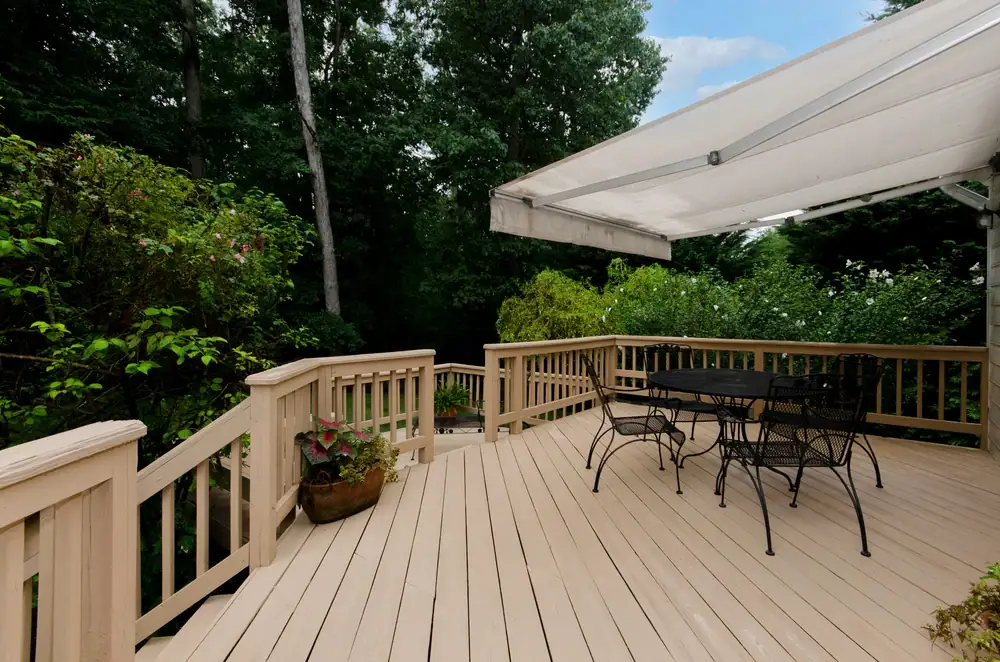
This is the red flag most homeowners never think to ask about — and it’s one of the most consequential. You hire a contractor, you shake hands, you sign a contract. Then a crew shows up on day one and you’ve never seen any of them before. Nobody from the company you hired is on site. When you call to ask, you get a vague explanation about “our guys.”
What you’re dealing with is a subcontractor situation. The company you hired is acting as a middleman — they sold you the job, and then they handed it off to someone else to build. That someone else may be skilled, or they may not be. They may follow the quality standards you were promised, or they may cut corners you won’t notice until two winters from now. Either way, when something goes wrong, the accountability gap is real.
A significant portion of deck and patio contractors in Suffolk County use subcontractors for at least part of the work. Some use them for almost all of it. The problem isn’t that subcontractors are inherently bad — it’s that you have no direct relationship with them, no ability to verify their credentials, and no clear line of responsibility if the work doesn’t hold up.
Ask every contractor you’re considering a direct question: will your own employees be doing the work, or will any of it be subcontracted out? The answer tells you a lot. A contractor who uses in-house crews exclusively can point to a consistent standard of work, direct accountability on site, and a team that understands the company’s methods from the ground up. That’s a meaningful distinction, especially on a structural project like a deck replacement where the quality of the work isn’t always visible from the surface.
A detailed written estimate is the single most important document in any contractor relationship. If you don’t have one — or if the one you received is light on specifics — that’s a problem worth taking seriously before you sign anything.
Vague estimates are how change orders happen. A contractor quotes you a number, starts the work, and then begins adding line items: the materials cost more than expected, there was an issue with the footings, the original quote didn’t include this part or that part. By the time the project is done, the number on your invoice looks nothing like the number you agreed to. We’ve seen cases where homeowners were billed more than 60% above their original quote — with no prior notice and no clear explanation.
A legitimate deck replacement contractor will give you a written estimate that specifies materials by type, grade, and quantity. It will include a clear payment schedule. It will tell you what’s covered and what isn’t. And it won’t change without your written approval. If a contractor can’t or won’t provide that level of detail upfront, the estimate you’re holding is not a real commitment — it’s a starting point for a negotiation that happens after the work is already underway.
In Suffolk County, where a full deck replacement project can represent a significant investment, the difference between a fixed-price contract and a vague estimate can mean thousands of dollars in unexpected costs. Don’t accept verbal assurances. Get the specifics in writing, and make sure the contract explicitly addresses what happens if scope changes during the project.
One more thing to watch: an unusually low bid. It’s tempting to go with the cheapest quote, but a price that’s significantly below every other estimate usually signals something — cheaper materials, unlicensed labor, skipped permits, or all three. The low bid often costs more in the end.
Want live answers?
Connect with a Corsino Construction expert for fast, friendly support.
Permits are one of the most misunderstood parts of any outdoor construction project — and one of the most consequential when they go wrong. In New York State, any deck attached to your home or more than 12 inches above grade requires a building permit, regardless of size. In Suffolk County, that means navigating your specific town’s building department, because each town has its own requirements and its own process.
A contractor who dismisses the permit question — or tells you it’s not necessary for a replacement project — is a red flag. So is a contractor who says they’ll “handle it” without being able to explain exactly what that means or which town’s department they’ll be working with.
Unpermitted decks create real problems. They can fail home inspections when you sell. They may need to be removed or rebuilt at your expense. And if something goes wrong structurally, your homeowner’s insurance may not cover it. The permit isn’t bureaucratic overhead — it’s the mechanism that ensures the work was done correctly and that someone with authority signed off on it.
New York State does not issue a statewide general contractor license. This surprises a lot of homeowners, and it’s something contractors who aren’t properly credentialed occasionally use to their advantage. Licensing in New York is handled at the local level — and in Suffolk County, the relevant credential is a Home Improvement Contractor (HIC) license issued by the Suffolk County Department of Labor, Licensing & Consumer Affairs.
Any contractor performing residential deck or patio work in Suffolk County is required to hold this license. It’s not optional, and it’s not something a contractor can work around by calling the project something else. If a contractor can’t provide their HIC license number when you ask, that’s a disqualifying red flag — full stop.
Beyond the HIC license, you should also verify that the contractor carries general liability insurance and workers’ compensation coverage. These aren’t formalities. If a crew member is injured on your property and the contractor doesn’t have workers’ comp, you could be held liable. If the work damages your home or a neighboring property and there’s no general liability policy, you’re absorbing that cost. Ask for certificates of insurance, not just verbal confirmation that they’re covered.
Some Suffolk County towns also have additional requirements beyond the county-level HIC license — particularly for structural work. A contractor who knows the local system will be able to tell you exactly what’s required in your town. One who can’t answer that question clearly probably hasn’t done much work in the area, regardless of what their website says.
The permit documentation itself is also worth understanding. Suffolk County building departments require more than just a permit application. They want a plot plan showing the deck’s footprint, setbacks from property lines, and distance from any pool or outbuilding. They want construction drawings with footing sizes, beam spans, joist layout, and railing details. Generic drawings get rejected. The drawings have to reflect your actual project. A contractor who handles this process regularly will know exactly what each town needs — and will be able to walk you through it without hesitation.
Suffolk County’s environment is harder on outdoor structures than most homeowners realize. The county’s proximity to the Atlantic Ocean and Long Island Sound means salt air is a constant presence — and salt air accelerates corrosion of metal fasteners, connectors, and hardware at a rate that inland contractors simply aren’t used to accounting for. A deck built with standard galvanized hardware might look fine for a couple of years. Then the fasteners start to fail, the ledger connection weakens, and you’re looking at a structural problem that wasn’t visible from the surface.
Beyond the coastal exposure, Long Island’s freeze-thaw cycles put real stress on deck footings. Footings in Suffolk County need to be installed below the frost line — typically 36 to 42 inches deep — to prevent the structure from heaving as the ground freezes and thaws through winter. A contractor who installs footings at the wrong depth isn’t cutting a corner you’ll notice immediately. You’ll notice it two or three winters later, when the deck has shifted and the railing no longer sits level.
These aren’t obscure technical details. They’re the baseline requirements for building anything that’s going to hold up on Long Island. A deck and patio contractor who has worked in Suffolk County for years understands them automatically. One who’s new to the area — or who’s used to building in a different climate — may not.
When you’re evaluating contractors, ask specifically about their experience with coastal builds. Ask what hardware they use and why. Ask how deep they set footings and how they determine that. A contractor who can answer those questions clearly, without hesitation, has actually done the work here. One who gets vague or defensive probably hasn’t — and that’s worth knowing before you hand over a deposit.
The same logic applies to patio projects. Drainage planning, frost heave, soil conditions — these all vary across Suffolk County, from the sandy soils of the East End to the heavier ground in mid-county communities like Coram and Centereach. A patio installation contractor who treats every job the same regardless of location is likely skipping steps that matter in the long run.
The red flags in this guide aren’t meant to make hiring a contractor feel overwhelming. They’re meant to make the process cleaner. When you know what to ask and what to watch for, the right contractor becomes much easier to identify — and the wrong ones disqualify themselves quickly.
What you’re looking for is straightforward: a contractor with a verifiable Suffolk County HIC license, in-house crews, a detailed written estimate that doesn’t change, a clear process for handling permits, and enough local experience to understand what building on Long Island actually requires. Those things aren’t hard to find if you know to ask for them.
If you’re planning a deck replacement or patio project in Suffolk County and want a straight answer on scope, timeline, and cost, we at Corsino Construction Corp have been doing this work here since 2000. Reach out and we’ll get back to you within 24 to 48 hours — no pressure, no runaround.
Article details:
Share:
Continue learning: